RV Power Without Hookups: How to Actually Run Your Rig Off-Grid
The real math behind boondocking power — what your RV draws overnight, what your batteries actually give you, and why the furnace is the number that ruins most trips.

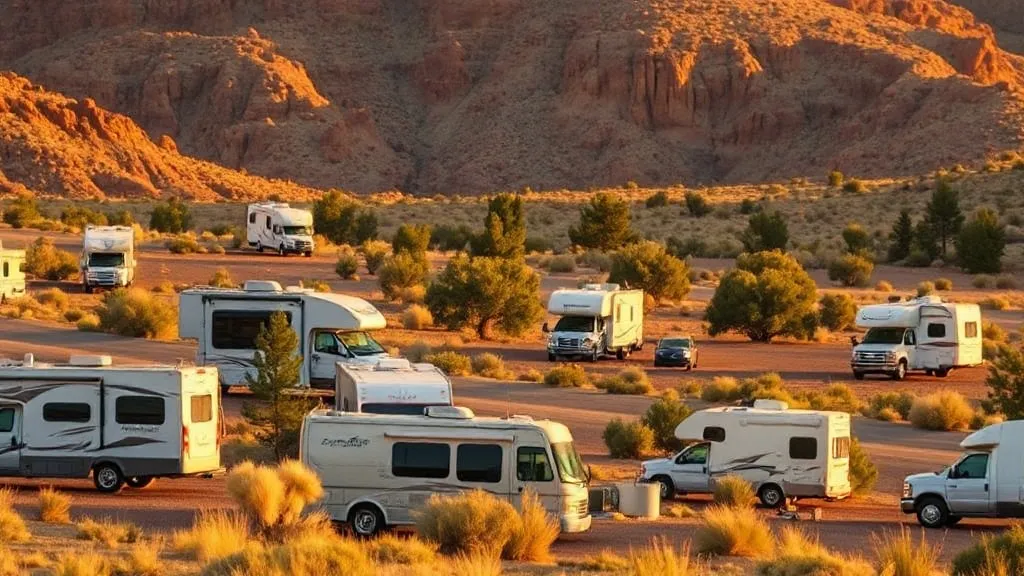
Most people who quit boondocking quit over electricity. Not the driving, not the dump stations, not the lack of a shower house — electricity. They pull into a beautiful spot on national forest land, spend a wonderful evening, wake up on the second morning to a dead battery, a furnace that won’t light, and a water pump that clicks and does nothing. They drive out and book a full-hookup site, and they never try it again.
The frustrating part is that this is entirely predictable. RV power off-grid is arithmetic. Every rig has a daily consumption number and a usable storage number, and if the first is larger than the second divided by the number of nights, you run out. There is no judgment call in it. But almost nobody does the arithmetic before they go, because the RV industry markets in amp-hours, watts, and watt-hours interchangeably and rarely tells you which capacity is actually available to you.
This guide is the arithmetic. What your rig draws, what your batteries really hold, what solar realistically returns, and where the honest limits are. It pairs with our beginner’s guide to boondocking, which covers the water, waste, and etiquette side. Here we are only dealing with the electrons.
The only number that matters: watt-hours per day
Amp-hours, watt-hours, and why RVers confuse them
RV systems are quoted in amp-hours (Ah) because the 12-volt side of the rig is where most of the load lives. Battery makers, solar sellers, and portable power companies quote watt-hours (Wh) because it’s the unit that works across both 12V and 120V. They measure the same thing, and the conversion is trivial:
watt-hours = amp-hours × battery voltageLead-acid batteries are nominally 12 volts. LiFePO4 batteries sit at about 12.8 volts. So a 100 Ah battery holds roughly 1,200 to 1,280 watt-hours on paper.
The word “paper” is doing real work in that sentence, and it’s the first place people lose a night’s power without realizing it.
What “100 amp-hours” actually gives you
- Flooded or AGM lead-acid: you get about 50% before you start meaningfully shortening the battery’s life. A 100 Ah lead-acid battery is a 50 Ah / ~600 Wh battery in practice. Two of them, the standard travel-trailer setup, give you about 1,200 usable watt-hours.
- LiFePO4 (lithium): you get 80–90% with no meaningful penalty, and the voltage stays high right down to the bottom instead of sagging. A 100 Ah lithium battery is genuinely an 85 Ah / ~1,080 Wh battery.
That is the whole reason lithium is worth its price. A single 100 Ah lithium battery replaces two 100 Ah AGMs, weighs about a quarter as much, and — importantly for anyone recharging from a generator — will accept full charging current almost to the top instead of crawling through a multi-hour absorption stage.
The rule that saves batteries: if your rig has lead-acid, treat 50% as empty. Not 20%, not “it still runs the lights.” Repeatedly pulling an AGM down to 30% will cost you the battery bank inside two seasons, which is more expensive than the lithium you didn’t buy.
What your rig actually draws overnight
Here is where the trip is won or lost. These are per-day figures for a typical travel trailer or Class C, in amp-hours at 12V and watt-hours:
| Load | Draw | Per day | Watt-hours |
|---|---|---|---|
| LED interior lights (6, ~4 hrs) | 0.15 A each | 3–4 Ah | 40–50 Wh |
| Water pump (normal use) | 4–7 A | 1–3 Ah | 15–35 Wh |
| Range hood / bath fan | 1–2 A | 1–2 Ah | 15–25 Wh |
| Roof vent fan (overnight, low) | 1–3 A | 8–24 Ah | 100–300 Wh |
| Absorption fridge on propane | 0.3–1.5 A (board only) | 3–10 Ah | 40–130 Wh |
| 12V compressor fridge | 3–6 A running, ~40% duty | 40–60 Ah | 500–750 Wh |
| Furnace blower | 3.5–8 A while cycling | 20–50 Ah | 250–600 Wh |
| CPAP, no humidifier | 30–40 W | ~20 Ah | 240–320 Wh |
| CPAP, heated humidifier | 60–90 W | 40–55 Ah | 500–700 Wh |
| Phones (×2) and a laptop | — | 8–10 Ah | 100–130 Wh |
| Parasitic: detector, boards, memory | 0.5–1.5 A continuous | 12–36 Ah | 150–450 Wh |
| Inverter left switched on, idling | 10–25 W continuous | 20–50 Ah | 240–600 Wh |
Two rows in that table deserve their own paragraph, because they are the two that surprise people.
The furnace is the largest single load in most RVs. Not the fridge, not the TV — the furnace. The blower motor pulls somewhere between 3.5 and 8 amps depending on the unit’s BTU rating, and on a genuinely cold night it cycles for a third of every hour. Ten hours of that at 6 amps is around 20 amp-hours; a poorly insulated rig at 25°F can easily hit 40 to 50. Detailed advice on managing this is in our cold-weather RV gear guide, but the short version is that a catalytic propane heater, which uses no electricity at all, is the single most effective off-grid upgrade a cold-weather camper can make.
Parasitic loads and a forgotten inverter are the invisible ones. Your propane leak detector never sleeps. Neither do the fridge control board, the stereo’s clock, the CO detector, or the slide-out controller. Together they’ll take 12 to 36 amp-hours a day whether you’re in the rig or on a hike. And if you leave a 2,000-watt inverter switched on because it’s easier than reaching for the switch, its own idle consumption can quietly cost you more per day than every light in the rig combined. Switch the inverter off when you’re not actively using it. This one habit buys some people an entire extra night.
A worked example: three nights on national forest land
Say you’re in a 25-foot travel trailer, dispersed camping in the Coconino National Forest outside Flagstaff in October. Nights drop to about 35°F. You have an absorption fridge running on propane. Three nights, no hookups, no driving in between.
| Load | Per day |
|---|---|
| Absorption fridge (propane, board only) | 100 Wh |
| Furnace cycling, 35°F night | 380 Wh |
| Lights | 50 Wh |
| Water pump | 25 Wh |
| Parasitic loads | 150 Wh |
| Phones × 2 + laptop | 100 Wh |
| Daily total | ~805 Wh (≈ 63 Ah) |
Three nights is roughly 2,400 watt-hours. Now check that against what people actually carry:
- Two 100 Ah AGM batteries — 2,400 Wh nominal, 1,200 Wh usable. You are flat somewhere in the middle of night two. This is the single most common boondocking failure, and it’s exactly what the couple who “tried it once” experienced.
- 200 Ah of LiFePO4 — 2,560 Wh nominal, about 2,180 Wh usable. You come up roughly 220 Wh short: you’d finish the third night with the furnace running on fumes. Close, but not comfortable, and this is a mild October — not January.
- 200 Ah lithium plus 200 W of solar — the panels return 500 to 700 Wh on an October Arizona day, so net drain drops to roughly 150 Wh per day. Now you’re not on a three-night trip at all. You’re on an indefinite one.
That last line is the point of solar, and it’s why the math matters more than the shopping. Storage buys you nights. Generation buys you the ability to stop counting nights.
Your four ways to put power back
Solar: budget 30–40%, never the number on the box
A 100-watt panel does not make 100 watts. It makes 100 watts at noon, in June, pointed square at a cloudless sun, at 25°C, when it’s new and clean. In the real world, on an RV roof, mounted flat:
- Good summer conditions: expect 300–400 Wh per day per 100 W of panel.
- Winter, northern latitudes, or partial shade: expect 100–200 Wh per day per 100 W.
The winter collapse is mostly about angle. A flat rooftop panel in December at 45° latitude is receiving sunlight at a glancing angle for a short day. Portable panels you can carry into a sunny clearing and tilt toward the sun will out-produce a larger flat rooftop array in winter — and they solve the other rooftop problem, which is that you have to park your entire rig in the sun to charge, in the exact season when you’d rather be under trees.
For a rig drawing 600 to 800 Wh per day, that means roughly 200 to 300 watts of panel for three-season use, and 400 watts or more if you camp through winter or spend real time in forest shade.
One more thing that catches people: an old PWM charge controller wastes a meaningful fraction of what the panels collect. If you’re adding panels to an older rig, an MPPT controller typically recovers 15–30% more in cold or low-light conditions. It’s the cheapest performance upgrade in the system.
The alternator: the one everybody forgets
If you are moving between spots, your tow vehicle or chassis alternator is charging as you drive. On most rigs the factory 7-pin wiring is thin enough that this trickles rather than charges — you might see 5 amps at the battery. A DC-to-DC charger changes that completely, pushing 20 to 60 amps into the house bank while you drive. Three hours of highway between camps can put 60 to 180 amp-hours back, which is often a full recharge for free.
For anyone who moves every few days, this is a better value than adding solar. For anyone who parks for two weeks at a time, it’s useless. Match the tool to how you actually travel.
Generators: fastest recharge, most restrictions
A 2,000-watt inverter generator will run your converter at full output and put back 45 to 55 amps an hour. It works in rain, in shade, at 3 AM in a snowstorm. It’s the only source that is completely weather-independent, which is why plenty of experienced full-timers still carry one even with a big solar array.
The catch is where you’re allowed to run it. On dispersed BLM and national forest land, generally anywhere, though courtesy still applies — see our BLM camping guide for the land-use rules. Inside developed campgrounds, generator hours are tightly restricted and enforced by neighbors as much as by rangers. Across the National Park Service campgrounds we’ve covered, the windows look like this:
- Upper Pines, Yosemite: three windows — 7–9 a.m., noon–2 p.m., 5–7 p.m., strictly enforced
- Mather, Grand Canyon: 7–9 a.m. and 6–8 p.m., with Pine Loop generator-free March 1–November 30
- Flamingo, Everglades: T Loop only, 8 a.m.–8 p.m.
- Furnace Creek, Death Valley: 7 a.m.–7 p.m.
- Watchman, Zion: typically 8–10 a.m. and 6–8 p.m. in designated areas, and not at all at the electric sites
Two patterns run through that list. The strictest parks give you two-hour blocks morning and evening — six hours a day at most, often four. The more relaxed ones give you a single daytime block, usually 8 a.m. to 8 p.m. Either way, verify at check-in: these schedules change, and individual loops are frequently generator-free even when the campground isn’t.
The four-hour version has a consequence worth spelling out. Two hours of generator time will not recharge a deeply discharged lead-acid bank, because lead-acid drops into a slow absorption stage above roughly 80% and takes hours to finish — you’ll claw back the easy 30% and then watch the ammeter fall away. Lithium doesn’t behave that way; it accepts full current nearly to the top. A lithium bank plus a short generator window is a genuinely workable combination. A lead-acid bank plus the same window is not, and that mismatch strands more people in national park campgrounds than any other single factor.
If you’d rather not manage this at all, our guide to national park campgrounds with full hookups covers the short list of places where the question doesn’t arise.
Shore power: use your hookup nights properly
If your trip alternates between boondocking and campgrounds — which is how most people actually travel — the hookup night is not just a shower. It’s your recharge event. Arrive with your batteries low, plug in, and leave with everything full: house bank, laptop, tool batteries, and anything portable. Our comparison of full hookup versus partial hookup sites covers what you’re actually paying for at each tier; for this purpose even a 30-amp electric-only site does the whole job.
Where a portable power station fits
Portable power stations — the suitcase-sized lithium boxes, sometimes sold as “solar generators” when bundled with panels — have become the most common addition to an RV power setup in the last few years. They’re also the most commonly misunderstood, so it’s worth being precise about what they do and don’t replace.
What it genuinely does for an RV
It’s a second, independent system. It has its own battery, its own inverter, and its own charging inputs, and it fails independently of your rig. When the converter dies in the middle of Nevada — and converters do die — the power station is still a working power system.
It runs AC loads without waking the big inverter. Charging a laptop from a 200-watt power station costs you 200 watts of station capacity. Doing it through a 2,000-watt inverter costs you that plus the inverter’s idle overhead all evening. For light AC use, the station is more efficient than the rig.
It sits where the load is. A CPAP at the bedside on its own battery means you’re not running the whole rig’s inverter all night for a 40-watt device — and it means a dead house bank doesn’t cost you a night’s sleep. If that’s your reason for buying one, size it against a full night’s use with the humidifier setting you actually run — and note that a heated humidifier can quadruple the draw versus running the machine dry.
It recharges from a wall in about an hour. Most units in the 1 kWh class refill from empty in 50 to 90 minutes on shore power. Your house bank cannot do that. So a hookup night genuinely resets it, and it arrives at the next boondocking spot full.
What it does not replace
Your 12V loads. The furnace, water pump, lights, slide motors, and fridge control board are hard-wired to the house bank. A power station cannot feed them without rewiring you almost certainly don’t want to do. Since the furnace is the biggest load in the rig, the power station leaves your actual problem untouched.
Capacity per dollar. A 1,000 Wh power station and a 100 Ah lithium house battery hold about the same energy. The house battery is usually cheaper, feeds everything in the rig, and charges from your existing solar and alternator. If your goal is simply more nights off-grid, add house battery first. Buy the power station for portability and redundancy, not for raw capacity — that’s the trade you’re actually making.
Air conditioning. A 13,500 BTU rooftop unit needs roughly 1,300–1,600 running watts with a large startup surge. One hour of cooling is about 1,500 Wh — more than most 1 kWh stations hold in total. Anyone selling you a portable box as an off-grid AC solution is selling you a very short afternoon.
Sizing one, if you decide you want it
The formula is the same one this whole guide runs on:
capacity Wh = (daily watt-hours you'll put on it) × days ÷ 0.85That 0.85 matters. Capacity is measured at the battery, but you draw at the outlet, and the inverter loses 10–15% in between. A “1,000 Wh” unit delivers roughly 850 Wh of AC energy — which is why real-world runtimes disappoint people who did the division without it. Run the division with the 0.85 in place before you trust any runtime figure, including the ones printed on the box.
Two practical notes for RV use specifically. First, check the inverter watts, not just the capacity — watt-hours decide how long you can run something, but watts decide whether it turns on at all. A 300 Wh unit with a 300 W inverter will not start a coffee maker regardless of how full it is. Second, weight is a real constraint in an RV in a way it isn’t at home: the 1 kWh class runs roughly 24 to 35 pounds, and the 2 kWh class is 50 pounds and up, which is a two-hand lift into a truck bed and a permanent resident of one storage bay.
Cold, heat, and altitude change the numbers
Cold hits you twice. The furnace runs more, and the batteries hold less. Lithium in particular loses usable capacity below freezing and — critically — most LiFePO4 batteries will refuse to accept a charge below 32°F unless they have internal low-temperature protection with a heater. A lithium bank in an unheated pass-through bay in Montana in November may simply not charge from your solar all day. Batteries with built-in heating solve this; check the spec before you buy, because it is not universal.
Heat costs you the biggest load of all. In summer, the thing you want is air conditioning, and as covered above, that is out of reach on batteries. This is why boondocking is a spring, fall, and winter activity across most of the southern half of the country, and why the Texas summer survival guide is mostly about finding shore power rather than avoiding it.
Altitude helps solar and hurts generators. Thinner, cleaner air at 8,000 feet means noticeably better panel output. It also means naturally aspirated generators lose roughly 3% of their rated output per 1,000 feet — a 2,000-watt unit is closer to 1,500 watts at Rocky Mountain elevations, which may no longer run your converter at full tilt.
Common mistakes
| Mistake | What it costs you | The fix |
|---|---|---|
| Treating a lead-acid bank as 100% usable | Half your capacity, then the batteries | 50% is empty. Plan around it or switch to lithium. |
| Leaving the inverter on all night | 240–600 Wh a day, silently | Switch it off when not in active use |
| Sizing solar off the nameplate wattage | A 60–70% shortfall against expectations | Budget 300–400 Wh/day per 100 W in summer, half in winter |
| Relying on the furnace off-grid | The single largest load in the rig | Catalytic propane heater, better bedding, warmer parking |
| Counting on a generator in a national park | Only 2–4 hours of charging a day | Confirm the loop’s generator hours before booking |
| No battery monitor | Total blindness — voltage lies under load | A shunt-based monitor is the highest-value $150 in the system |
| Buying a power station instead of house battery | Paying more for energy that can’t reach your 12V loads | Add house capacity first; add the station for portability |
| Forgetting the parasitic loads | 12–36 Ah/day unaccounted for | Measure at the shunt with everything “off” |
That battery-monitor line is worth emphasizing. Voltage is a terrible gauge of state of charge under load, and it is essentially useless on lithium, whose voltage barely moves from 90% down to 15% and then falls off a cliff. A shunt-based monitor counts amp-hours in and out and tells you the truth. Almost everyone who successfully boondocks for long stretches has one, and almost everyone who runs out unexpectedly does not.
The short version
- Work out your daily watt-hours before the trip. Everything else follows from that one number.
- Halve your lead-acid capacity on paper. That’s what you actually have.
- The furnace is your biggest load. Budget 250–600 Wh a night for it in cold weather, or eliminate it with a catalytic heater.
- Kill the parasitic draws. Switch the inverter off. Know what the detectors and boards cost you.
- Budget solar at 30–40% of nameplate. 200–300 W for three-season use, 400 W+ for winter.
- Add a DC-to-DC charger if you move often. It’s free energy you’re currently throwing away.
- Fit a shunt-based battery monitor. Voltage lies. Amp-hours don’t.
- Buy house battery for capacity, a power station for portability. They solve different problems.
Do those eight things and boondocking stops being a gamble. You’ll know on the drive in how many nights you have, and you’ll know which one of them the weather can take away from you. For where to actually go once the power side is solved, start with our guide to free RV camping across the USA and the best free camping apps for finding spots on the day.
Frequently Asked Questions
How many batteries do I need to boondock for a week?
Work backwards from your daily draw. At a typical 600–800 Wh per day, seven nights is 4,200–5,600 Wh, which is roughly 400–500 Ah of lithium or 800 Ah of lead-acid — an unrealistic amount of weight and money for most rigs. This is precisely why nobody boondocks for a week on storage alone. A week off-grid is a solar problem, not a battery problem. Around 300–400 W of panel plus 200 Ah of lithium is the more common shape of a setup that genuinely holds out for a week.
Can I charge my RV batteries with a portable power station?
Technically yes, through a battery charger plugged into the station’s AC outlet, but you’ll lose 15–20% to the double conversion and you’re moving energy from a small battery to a large one for no gain. It makes sense only in an emergency — enough charge to light the furnace igniter and get moving. The energy is better spent directly on the AC loads the station is good at.
Do I need an inverter if I have a portable power station?
For light AC use, often not, and that’s a genuine saving — no idle draw and no big install. But an inverter wired to the house bank draws on your entire storage capacity and every charging source feeding it, which a power station can’t do. Most people who boondock seriously end up with both, using the inverter for anything heavy and the station for anything they’d rather keep independent.
What’s the difference between a solar generator and a portable power station?
Nothing, other than packaging. “Solar generator” is a marketing term for a power station sold bundled with portable panels. There’s no separate technology, and the term is worth ignoring when you compare specs — look at capacity in watt-hours, inverter output in watts, solar input in watts, and battery chemistry instead.
Is lithium worth the upgrade for occasional boondocking?
If you boondock a handful of nights a year and always in mild weather, probably not — two AGMs and disciplined power use will cover it. If you boondock in cold weather, run a 12V compressor fridge, or recharge from a generator inside restricted campground hours, lithium changes the trip rather than just improving it. The doubling of usable capacity and the ability to absorb a fast charge are what turn a two-night trip into a five-night one.
Frequently asked questions
How long can an RV run without hookups?
For most rigs on two 100-amp-hour lead-acid batteries, one to two nights in mild weather, and often less than one night if the furnace runs. The limit is almost never fresh water or propane — it's usable battery capacity. Two 100 Ah flooded or AGM batteries hold about 2,400 watt-hours on paper but only about 1,200 watt-hours you can safely use, and a typical trailer burns 600 to 900 watt-hours a day once the furnace and the parasitic loads are counted.
How much power does an RV use per day when boondocking?
In mild weather with an absorption fridge on propane, a typical trailer uses 30 to 45 amp-hours per day, or roughly 400 to 600 watt-hours. Add a 12V compressor fridge and it jumps by 40 to 60 amp-hours. Add furnace cycling on a 35°F night and it jumps by another 25 to 50. Cold-weather boondocking commonly doubles a rig's daily draw.
How much solar do I need to boondock full time?
Expect roughly 300 to 400 watt-hours per day from every 100 watts of panel in good summer sun, and half that in winter or partial shade. Matching a typical 600 to 800 watt-hour daily draw therefore means about 200 to 300 watts of panel in summer and 400 watts or more if you camp through winter at northern latitudes. Rooftop panels mounted flat lose the most in winter, when the sun sits low.
Is a portable power station worth it for an RV?
It's worth it as a second, parallel system — not as a replacement for house batteries. Your furnace, water pump, and lights are wired to the house bank and a power station can't feed them without rewiring. What a power station does well is run AC-side loads directly: a CPAP at the bedside, a laptop, a coffee grinder, camera batteries, a residential fridge during a transfer. It also recharges from a wall outlet in about an hour on your hookup nights, which house batteries cannot.
Why does my RV battery die so fast when boondocking?
Usually three reasons, in this order. First, if it's a lead-acid battery you only have half its rated capacity available — draining past 50% shortens its life sharply. Second, the furnace blower draws 3.5 to 8 amps every time it cycles, which on a cold night is the single largest load in the rig. Third, parasitic draws — the propane detector, control boards, stereo memory, and especially an inverter left switched on — can quietly consume 20 to 50 amp-hours a day while you're asleep.
Can I run my RV air conditioning off batteries?
Realistically, no, not on a standard battery bank. A 13,500 BTU rooftop unit draws roughly 1,300 to 1,600 watts running with a much larger startup surge, so one hour of cooling costs about 1,500 watt-hours — more than two full 100 Ah lithium batteries' usable capacity for a single hour. People who do run AC off-grid have 600+ amp-hours of lithium, a large inverter, a soft-start, and a big solar array, and it's still a short-duration luxury rather than an all-afternoon plan.
About the author
Dale HartmanLead RV Park Reviewer
Dale has lived on the road full-time since 2014, when he sold the house in Boise and moved into a 34-foot fifth wheel with his wife and a stubborn beagle named Otis. In the years since, he's parked at more than 400 campgrounds across 41 states — from boondocking sites with no hookups to luxury resorts with concrete pads and pickleball courts.
More from Dale →Keep reading
KOA Journey vs Holiday vs Resort: KOA Campgrounds Compared, Prices & Rewards (2026)
KOA campgrounds explained for RVers: the difference between KOA Journey, Holiday and Resort with live 2026 RV site prices from 20 KOAs, what each tier includes, what KOA Rewards costs ($39 a year for 10% off), Patio Sites, booking tricks and the KOAs we've reviewed.
Best Free Camping Apps for Boondocking: 2026 Comparison
Compare the best free camping and boondocking apps in 2026, including Campendium, iOverlander, The Dyrt, onX Offroad, and Recreation.gov.
Central Texas RV Camping Guide: Seasons, Heat & Routing the Austin–San Antonio Loop
A planning guide to RV camping in Central Texas — best seasons, beating the summer heat, reservation strategy, and routing between Austin, San Antonio, and the Hill Country.