BLM Camping Guide: Official 14-Day Rules & Free Camping
BLM dispersed camping is generally free and limited to 14 days in 28, but local rules control. Check permits, relocation rules, maps, and LTVA fees.

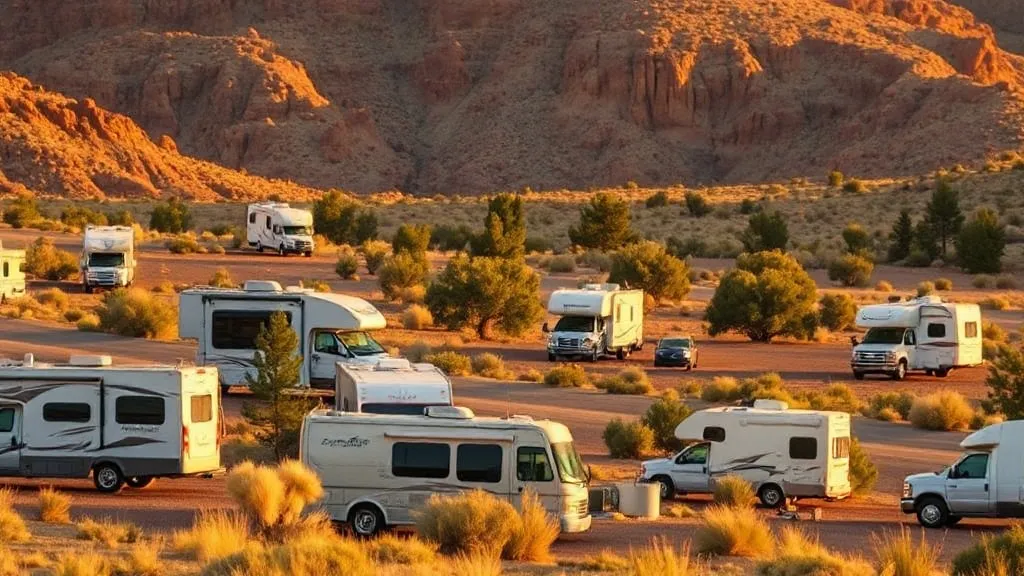
Most BLM land allows dispersed camping unless it is closed or restricted, and ordinary dispersed sites are generally free. BLM’s national guidance says stays are usually limited to 14 days within 28—but the exact limit, required move distance, permits, and road rules are local. Open the destination page or contact its field office before driving in.
That distinction matters: the familiar “14 days, then move 25 miles” wording is a real local rule in some districts, not one universal nationwide sentence. This guide separates the national BLM camping guidance from concrete local examples and current Long-Term Visitor Area fees.
This is the deep-dive companion to our broader free RV camping and boondocking guide — if you want the full menu of free-camping options (national forests, Corps lakes, Harvest Hosts, and more), start there and come back here for the BLM specifics.
What BLM land is and why it’s open to camping
The Bureau of Land Management is a federal agency that administers public land primarily across the western states. Unlike national parks (preservation-focused) or national forests (managed by a separate agency for multiple use), BLM land is managed for an explicit mix of uses — grazing, mining, recreation, conservation — and dispersed recreation, including camping, is one of those legitimate uses.
Most BLM land permits dispersed camping unless a closure, land-use plan, conservation restriction, or local order says otherwise. Developed BLM campgrounds and special recreation areas can have fees and reservations even when nearby dispersed land does not.
The practical consequence: across much of the West, an established disturbed site may be available without a reservation or campsite fee. Verify the parcel, legal motorized route, posted restrictions, and stay limit first.
How BLM dispersed camping works
“Dispersed camping” is the official term for camping outside of a developed campground — no hookups, no facilities, no fee. On BLM land it works like this:
- No reservation, first come first served. There are no assigned sites and no booking system for dispersed camping. You find an open spot and take it.
- Camp on existing disturbed sites. You’re expected to use spots that have clearly been camped before — a pullout, a flat clearing, an old fire ring. Creating new sites or driving off established roads damages the land and is often prohibited.
- No cost. Ordinary dispersed camping is free.
- Pack it in, pack it out. No trash service. Everything you bring leaves with you.
- Self-contained. No water, no toilets, no power. You live off your rig’s systems.
Field tip: The quality gap between BLM sites is enormous. A pullout 200 feet off a paved highway and a flat bench a mile down a dirt road are both “free BLM camping,” but one is a noisy gravel patch and the other is a private desert amphitheater. Drive a little farther than feels necessary — but match the road to your rig.
The 14-day rule, explained
BLM’s national page says dispersed camping is generally limited to 14 days within a 28-day period. It also says limits vary by state and field office, and campers often need to move 25–30 miles after reaching the limit. “Generally” and “often” matter: the destination’s published rule controls.
A few clarifications that matter:
- Local orders make the exact rule enforceable. For example, BLM Southern Nevada publishes a 14-day maximum in 28, followed by 14 days outside a 25-mile radius or on non-BLM land.
- The window and distance can differ. Heavily used or protected areas may publish shorter limits, permit systems, or closures. Check the destination page and posted notices, not just a mapping-app pin.
- “Area” is interpreted broadly. You can’t simply move 200 yards down the road and reset the clock. The intent is to prevent permanent occupation of public land.
| Rule layer | What to use |
|---|---|
| National starting point | Generally 14 days in 28; local limits vary; relocation is often 25–30 miles |
| Southern Nevada example | 14 days in 28, then outside a 25-mile radius or off BLM land for 14 days |
| Your campsite | The current destination page, field-office order, kiosk, and closure notices |
Field tip: Don’t treat 14 days as a target — treat it as a ceiling. Your water, gray, and black tanks will almost always force a move long before day 14, and rotating sites every few days gives you fresh scenery and keeps you well within the rules without ever thinking about them.
Long-Term Visitor Areas (LTVAs) and Quartzsite
If you want to stay put for a whole winter, the 14-day rule is a problem — and that’s exactly what Long-Term Visitor Areas solve. LTVAs are specific BLM zones in Arizona and California where, for a paid permit, you can camp continuously through the winter season instead of moving every two weeks.
The current La Posa LTVA page lists:
- Season runs September 15 to April 15. That’s the seven-month window when LTVA permits apply.
- Season permit: $180. This lets you camp in any designated LTVA continuously, or for any length of time, between those dates.
- Short-visit permit: $40. Good for 14 consecutive days and renewable.
- Off-season (April 16 to September 14): the LTVAs revert to standard rules — roughly $10/day-use or $15/night per vehicle (or $75 annually), with the normal 14-in-28 stay limit.
BLM says the permit is honored across designated LTVAs, so you can move between them on one permit. Recheck the live page before arrival because fees and services can change.
Quartzsite and La Posa
The epicenter of LTVA camping is Quartzsite, Arizona. The main LTVAs here are the La Posa units south of town off Highway 95. The official page currently lists ten accessible vault toilets, eight water faucets, dump facilities, and trash service. Service availability can change, so do not arrive dependent on a single faucet or dump station. Other LTVAs in the network include Imperial Dam near Yuma and Midland in California near Blythe.
Quartzsite’s draw is the combination of warm winter weather, the famous January gem and RV shows, an enormous boondocking community, and easy big-rig access. If you’re chasing the snowbird scene, pair this with our Arizona snowbird RV parks guide, which covers the paid-park side of the same region, and our Quartzsite RV parks guide for La Posa details and the free 14-day areas around town.
Quartzsite choice: La Posa’s paid permit buys an extended winter stay and listed services. Nearby ordinary dispersed areas use their own current local stay, access, and permit rules; verify the exact parcel rather than assuming the national general limit is the posted local rule.
Renting an RV for this trip? Compare rigs, prices, and pickup locations on RVshare and Outdoorsy — both let you filter by rig size, dates, and location.
Finding legal BLM sites
The hardest part of BLM camping isn’t the rules — it’s confirming that the spot you’re eyeing is actually BLM land where camping is allowed. Boundaries between BLM, state trust land, national forest, tribal, and private parcels can shift every quarter mile, and there’s rarely a sign. Camping on the wrong side of an invisible line is trespassing.
The workflow that works:
- Verify ownership. Use the official BLM map or another current ownership map to confirm the parcel is BLM. A land-ownership layer does not by itself prove camping is open.
- Check for site-specific rules. Look for posted restrictions — shortened stay limits, permit requirements, seasonal closures (desert tortoise habitat closures are common in spring), or fire bans.
- Read recent reviews. Campendium and other current campground databases carry user reports on road conditions, rig-size suitability, cell signal, and whether a site is currently accessible.
- Have a backup. Sites fill, roads wash out, and what looked flat on satellite can be a rutted mess. Always know a fallback nearby.
We compare these tools in detail in our best free camping apps guide — that’s the place to start if you’re choosing which to download.
The best BLM states for camping
BLM land is overwhelmingly western, and some states are far better endowed than others:
- Arizona — The free-camping capital. Quartzsite, the LTVA system, Sonoran Desert sites, mild winters. Best October through April.
- Nevada — Vast, empty, and over 60% federally managed. Great Basin solitude, hot springs, easy access off the interstates.
- Utah — Spectacular red-rock BLM camping near Moab, near the national parks, and across the southern desert. Spring and fall are ideal; summer is brutal at low elevation.
- California — Huge BLM footprint in the deserts and Eastern Sierra. Alabama Hills (permit required), Anza-Borrego-area BLM, and more in our California free camping guide.
- Colorado — High-country BLM and a generous mix with national forest land, best in summer.
- New Mexico — Underrated, uncrowded desert and high-plains camping.
- Oregon, Idaho, Montana, Wyoming — Strong Mountain West holdings, summer-focused, snowbound much of the year. See our Montana boondocking guide.
- Texas — Worth a note as the cautionary example: despite its size, Texas has almost no BLM land because the state retained its public lands at statehood. Free camping there relies on national forests and other sources, covered in our Texas free camping guide.
East of the Rockies, BLM land essentially disappears. If you’re traveling the Midwest, South, or East Coast, you’ll lean on national forests and Corps of Engineers lakes instead — both covered in our free RV camping guide.
Honest trade-offs of BLM camping
Free and scenic doesn’t mean carefree. The realities:
- No services. No water, power, sewer, or trash. You’re fully self-contained, and your stay length is capped by tank capacity, not just the law.
- Access is hit or miss. Many BLM roads are fine for any RV; others are sand, washboard, or rutted clay that will strand a big rig. Reviews and daylight arrivals are your friends.
- Cell signal is unpredictable. Some desert spots have strong line-of-sight LTE; others have nothing. If you work on the road, check coverage reports before committing.
- Weather exposure. Desert sites bake in summer and can flood in flash storms; high-elevation sites are cold and snowbound much of the year. There’s no shelter but your rig.
- It’s on you. No host, no hookups, no help. The freedom is the whole point, and the responsibility is the price.
Planning a BLM camping trip
Pull it together with a simple plan:
- Match the season to the region. Desert Southwest in winter (roughly November–March), Mountain West in summer (June–September). Camping the desert in July or the mountains in January is a mistake newcomers make once.
- Provision fully. Full fresh-water tank plus extra jugs, empty gray/black tanks, full fuel, charged batteries (solar pays for itself here), and a food buffer.
- Scout and verify. Confirm land status with onX or the BLM map, read recent reviews, and pick a primary site plus a backup.
- Arrive in daylight, camp on disturbed ground, and respect the posted local limit. BLM’s national guidance also recommends staying within 150 feet of a designated route and at least 200 feet from water.
- Leave no trace. Pack out everything, never dump on the ground, and observe fire restrictions. Every closed BLM area is a monument to people who didn’t.
Get comfortable with BLM camping and the cost equation of RV travel changes completely. The land is public, the price is zero, and the views — Sonoran sunsets, red-rock mesas, Great Basin silence — routinely beat the parks charging $80 a night just up the road.
New to all of this? Start with our boondocking tips for beginners, then grab the right tools from our best free camping apps roundup before you head out.
Frequently asked questions
Is BLM camping free?
Most ordinary dispersed camping on BLM land is free and needs no reservation, but developed campgrounds, Long-Term Visitor Areas, high-use zones, and permit areas can charge fees. Confirm the destination page and current field-office rules before travel.
What is the BLM 14-day rule?
BLM's national guidance says dispersed camping is generally limited to 14 days within a 28-day period, but state and field-office rules vary. Some local orders require a 25- or 30-mile move; use the exact destination page or responsible field office for the enforceable limit.
How do I find legal BLM camping spots?
Use the official BLM map or a current mapping app such as onX Offroad to identify BLM parcels, since boundaries with private and state land are rarely signed. Then use recent Campendium reports for road conditions, rig-size suitability, and cell signal. An app pin is not permission to camp, so confirm local rules and use an existing disturbed site.
What are BLM Long-Term Visitor Areas?
Long-Term Visitor Areas (LTVAs) are designated BLM zones in Arizona and California that allow extended winter camping with a paid permit. The current La Posa page lists a $180 long-term permit for September 15–April 15 and a renewable $40 permit for 14 consecutive days.
Which states have the best BLM camping?
Arizona, Nevada, Utah, California, Colorado, New Mexico, Oregon, Idaho, Montana, and Wyoming hold the most accessible BLM land. Arizona and the Desert Southwest are best in winter, while the Mountain West states shine in summer. East of the Rockies, BLM land is scarce, so national forests and Corps of Engineers lakes fill the gap.
Do you need a permit to camp on BLM land?
Most ordinary dispersed-camping areas do not require a permit, but local high-use, conservation, group, fire, fee, and Long-Term Visitor Area rules can require one. Check the destination page and field-office notices before arrival.
About the author
Marisol ReyesCamping & Outdoors Editor
Marisol spent six years as an interpretive ranger in the California and Colorado state park systems before turning to writing full-time. She knows public-land camping from the inside — how reservation windows really work, why some loops fill before others, and which 'first-come, first-served' sites are worth gambling on.
More from Marisol →Keep reading
Mesa & Apache Junction RV Resorts: 12 Parks With 2026–27 Rates
The East Valley snowbird deep dive: Mesa Spirit, Viewpoint, Valle del Oro, Monte Vista, Towerpoint, Mesa Regal, Sun Life, Good Life, Val Vista Villages, the Mesa/Apache Junction KOA, Lost Dutchman State Park and Usery Mountain, with 2026–27 nightly, monthly and seasonal rates, 55+ rules and short-stay policies.
Quartzsite RV Parks: 10 Hookup Parks, La Posa LTVA and Free BLM (2026–27)
Park-by-park guide to RV camping in Quartzsite, Arizona for the 2026–27 snowbird season: full-hookup parks with verified nightly, monthly and seasonal rates, the La Posa LTVA permit, the five free 14-day BLM areas, and the January 2027 show dates.
Yuma RV Parks: 12 Best Snowbird Resorts and BLM Camps (2026–27)
Verified 2026–27 guide to RV parks in Yuma, Arizona: Sun Vista, Westwind, Fortuna de Oro, Caravan Oasis, Bonita Mesa, Villa Alameda, Cocopah Bend, Yuma Lakes, the River Front KOA, Winterhaven across the river, and BLM boondocking at Imperial Dam LTVA and Senator Wash, with nightly, monthly and seasonal rates, 55+ rules and the Los Algodones day trip.