Sedona RV Parks & Camping: Red Rock Country on a Budget (Sort Of)
The honest guide to RV camping in Sedona — limited options, premium prices, and the national forest alternatives that save you $100/night without sacrificing the views.

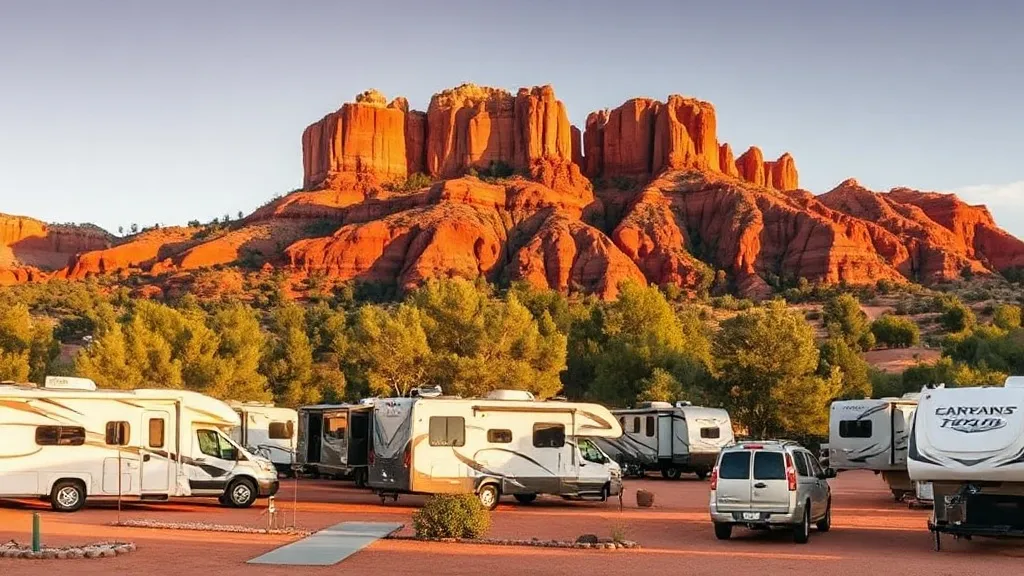
Sedona is one of the most visually absurd places in the American Southwest. Red sandstone buttes rise straight out of juniper and pinyon forest like someone dropped a Utah canyon into a Prescott hillside. Cathedral Rock at sunset. The view from Airport Mesa after a rainstorm. Bell Rock glowing orange at first light. The landscape does not require embellishment — it is genuinely that striking, every single day.
Here is the problem if you are arriving in an RV: Sedona does not want to be a destination for large rigs. The town itself is small, wedged into Oak Creek Canyon with limited flat land. There are exactly two private RV parks within city limits. Two. In a town that draws three million visitors per year. The result is predictable — pricing is steep, availability is scarce during peak season, and you will need to book months ahead for anything resembling a decent site. Sedona is one of the regions covered in our roundup of the best RV parks in Arizona.
But there is a workaround, and it is a good one. Sedona sits inside the Coconino National Forest, which means dispersed camping is available on forest roads within twenty minutes of town. And the Verde Valley — Cottonwood, Camp Verde, Clarkdale — offers state park and private campgrounds at a fraction of Sedona pricing, with the red rock views still visible from your camp chair. The trick is knowing which option fits your rig, your budget, and your tolerance for roughing it.
This guide covers every realistic option, from the premium riverfront sites to the free dirt pulloffs on Forest Road 525. We wrote it for people who want to wake up near those red rocks without pretending the logistics are simple. For more Arizona options, see our Arizona snowbird guide or browse the full Arizona state page.
Private RV Parks in Sedona
The pickings are slim. Sedona’s geography and zoning laws have kept RV park development to a minimum, which means the parks that exist have little incentive to compete on price. You are paying for location, period. Both options below are solid facilities, but go in with your expectations calibrated — this is not Texas pricing.
Rancho Sedona RV ParkPark details →
Rancho Sedona’s advantage is its in-town Oak Creek setting. Current pricing is site-specific rather than seasonal: published nightly tiers run from $56 partial hookup to $124 executive/Hill Top, before tax. Standard full-hookup tiers are $69 and $88, with higher-priced pull-through and premium inventory.
Do not assume every site has sewer. Sites 25, 26, 65 and 65A include water, electricity and Wi-Fi but no sewer; the full-hookup categories include electric, water, sewer, digital cable and Wi-Fi. Exact rig fit also depends on the numbered site, so provide the complete length, tow configuration and slideouts before reserving.
- Hookups: Mixed — four partial water/electric sites; full hookups in other published nightly categories
- Cost: $56–$124/night + tax by site; Good Sam/AAA discount where listed
- Monthly: Selected adult-only sites $850–$950 + electricity
- Max RV length: Exact assigned site controls
- Rules: No generators, campfires or propane fire rings
- Reservation: Official Rancho Sedona booking information
- Full review: Rates, sites, fees and cancellation terms
Cost reality: Compare the exact site and full-party total. Extra guests currently cost $5/night ages 6–15 or $15/night ages 16+, and dogs cost $2/night.
Lo Lo Mai Springs Outdoor ResortPark details →
Lo Lo Mai is the oddball option, and it is worth considering if you want something different. Located about 12 miles southwest of Sedona in the Verde Valley (technically between Cornville and Cottonwood), this is a privately owned resort built around natural spring-fed pools and Oak Creek access. The setting is lush — massive cottonwood trees, manicured grounds, the spring pools staying around 74 degrees year-round. It feels more like a rural retreat than an RV park.
The RV section has full hookups and a mix of pull-through and back-in sites. The facilities are dated in places — this is not a brand-new build — but the grounds crew keeps things tidy and the pool areas are the highlight. There are multiple spring-fed swimming pools, a creek beach area, and enough shade from the cottonwood canopy that summer heat is more manageable than in Sedona proper.
Pricing is lower than Rancho Sedona but still in premium territory for Arizona. Expect $55 to $80 per night depending on season and site type. Monthly rates for snowbirds are available and considerably more reasonable. The main downside is the drive into Sedona: about 20 minutes each way on 89A, and you will be dealing with Sedona traffic if you are going in during peak hours.
Lo Lo Mai also books up. The snowbird crowd discovers this place and comes back year after year, which means winter spots often fill by late summer. The spring-fed pools are genuinely unique for an RV park in Arizona, and that keeps the repeat visitor rate high.
- Hookups: Full (water, electric 30/50 amp, sewer)
- Sites: ~90 RV sites
- Max RV length: 40 feet
- Cost: $55–80/night; monthly rates available (inquire directly)
- Cell signal: Moderate — Verizon and AT&T work; T-Mobile is spotty in the valley
- Season: Year-round
- Reservation: lolomai.com — book well ahead for winter and spring
- Dump station: On-site
- Showers/Laundry: Yes
- Pets: Allowed in designated areas
- Unique feature: Natural spring-fed swimming pools (74°F year-round)
Best for: Snowbirds staying a month or more who want a base near Sedona without Sedona pricing. The spring pools are a genuine amenity, not a gimmick.
Dead Horse Ranch State Park (The State-Park Play)Park details →
Dead Horse Ranch is not in Sedona. It is in Cottonwood, about 20 minutes southwest, and it is the option that saves your budget without making you feel like you are roughing it. This is a well-run Arizona State Park with a developed campground, lagoon fishing, creek access, and trails that connect to the Verde River Greenway.
The park’s Quail, Red-Tail, and Cooper’s Hawk loops contain 106 RV-capable sites with water and 30/50-amp electric. There are no sewer connections at the sites, but registered campers can use the dump station and showers. The separate 17-site Blackhawk loop is tent-only: RVs, camper vans, and truck campers are not permitted there.
The drive into Sedona from Dead Horse Ranch uses 89A and adds a commute compared with staying in town. The trade-off is that the state-park setting includes lagoons, the Verde River Greenway, trails, showers, and a dump station. Electric sites currently cost $50 per night plus the $3.60 reservation fee, so this is no longer a bargain-basement campground—but it can still undercut a premium private park.
- Hookups: Water and 30/50-amp electric at 106 RV sites; no sewer hookup at the site
- Sites: 106 RV-capable electric sites across three loops; 17 additional sites are tent-only
- Max RV length: Most pull-throughs accept motorhomes to 40 feet or truck-and-trailer combinations to 65 feet; the selected site’s limit controls
- Cost: $50/night for an electric site plus a $3.60 reservation fee
- Cell signal: Good in Cottonwood
- Season: Year-round
- Reservation: Arizona State Parks — book up to 365 days ahead; spring and fall sell out
- Dump station: Yes
- Showers: Yes
- Pets: Allowed on leash
- Generators: Prohibited
Read our complete Dead Horse Ranch State Park camping review for the loop breakdown, rig-fit rules, cancellation deadlines, and the important tent-only restriction.
National Forest Dispersed Camping
This is the section the budget-conscious crowd came here for. Sedona is surrounded by the Coconino National Forest, and dispersed camping — free or nearly free camping on forest land — is available on multiple forest roads within a short drive of town. The views from some of these spots rival anything you would see from a paid campground. The trade-offs are no hookups, no services, and roads that will test your rig’s clearance.
How Dispersed Camping Works Here
The Coconino National Forest allows dispersed camping in most areas unless specifically posted otherwise. The rules are standard USFS: camp at least one mile from any developed campground, do not block roads or gates, pack out all trash, and follow fire restrictions (which are common and strictly enforced during dry months). The maximum stay is 14 days within a 30-day period. After 14 days, you must move at least 5 miles.
Sedona does require a Red Rock Pass for parking at most trailheads and day-use areas. If you are dispersed camping on forest roads, you do not need the pass at your campsite, but you will need one ($5 daily, $15 weekly, $20 annual) if you park at a trailhead during the day. An America the Beautiful pass covers it.
Forest Road 525 (Dry Creek Road Area)
FR 525 is the most popular dispersed camping corridor near Sedona, and for good reason. It runs north from Dry Creek Road through pinyon-juniper forest with views of the red rock formations to the south and east. Pulloffs and established dispersed sites line the road for several miles, many with fire rings left by previous campers and enough flat ground for a single rig.
The first few miles of FR 525 are graded dirt and passable for most RVs up to about 30 feet. Beyond that, the road surface degrades and high-clearance becomes necessary. The established pulloffs closest to the pavement fill up fast during peak season — arrive early in the week or early in the morning to claim a spot. By Friday afternoon in March, everything within the first two miles is taken.
The views from many of these sites are remarkable. You are looking south at the red rock formations from an elevated vantage point, and at sunset the light turns them colors that do not seem real. There is no running water, no restrooms, no trash service — you need to be fully self-contained. Cell signal is limited but Verizon usually holds a bar or two at the higher-elevation sites.
- Cost: Free (Red Rock Pass not required at dispersed sites)
- Road surface: Graded dirt first 2–3 miles, then rough and high-clearance
- Max practical RV length: 25–30 feet on main corridor; smaller for side roads
- Water: None — bring your own
- Restrooms: None — pack a portable toilet or use proper waste disposal
- Fire restrictions: Check with Red Rock Ranger District; fire bans are common May–September
- Cell signal: Limited — Verizon best, AT&T marginal, T-Mobile unlikely
Schnebly Hill Road Area
Schnebly Hill Road is famous as one of the most scenic drives in the Southwest — a rough dirt road that climbs from Highway 179 south of Sedona up to the Mogollon Rim, with panoramic views of the entire Sedona valley. The dispersed camping along this road is stunning, but the road conditions are genuinely challenging.
The first mile from the highway is paved and leads to the Schnebly Hill Vista parking area. Beyond that, the road turns to rough, rocky dirt with steep grades and tight switchbacks. This is a high-clearance, low-range-friendly road. Do not attempt it in any RV over 20 feet. Even smaller rigs will bounce around on the washboard and rocks. Truck campers and rugged van builds are the sweet spot here.
Dispersed sites along the upper sections of Schnebly Hill Road offer some of the most dramatic free camping in Arizona. You are at elevation — around 6,000 feet — with views stretching from Cathedral Rock to the San Francisco Peaks near Flagstaff. Nights are significantly cooler than in town, which is a genuine advantage during summer months.
- Cost: Free
- Road surface: Rough, rocky dirt — high clearance and 4WD recommended
- Max practical RV length: 20 feet absolute maximum; truck campers and vans ideal
- Water: None
- Cell signal: Intermittent at best
- Best for: Adventurous campers with small, capable rigs who want solitude and views
Forest Road 618 and Other Options
Several additional forest roads around Sedona offer dispersed camping. FR 618 south of the Village of Oak Creek has a handful of established sites with red rock views. FR 153 near Beaverhead Flat is another option, though it is less scenic. Forest roads off 89A between Sedona and Cottonwood occasionally have pulloffs, but many are posted as no-camping due to their proximity to town.
The Red Rock Ranger District office on Highway 179 is your best resource for current conditions. Stop in and ask which roads are open, where fire restrictions apply, and which areas have been closed for restoration. The rangers are helpful and will steer you toward available sites based on your rig size.
Generator etiquette: Even on forest land, running a generator at 6 AM will earn you glares from tent campers and van-dwellers at nearby sites. Keep it to reasonable hours (8 AM to 8 PM is the accepted standard) and point the exhaust away from neighbors.
Verde Valley Alternatives
The Verde Valley — the stretch of high-desert lowland running southwest from Sedona through Cottonwood, Clarkdale, and Camp Verde — is where Sedona visitors go when they want real campground amenities without Sedona pricing. The trade-off is straightforward: you are 15 to 30 minutes from the red rocks instead of inside them. For most people, that trade-off is worth several hundred dollars per week.
Verde Ranch RV Resort
Verde Ranch is the large, amenity-heavy alternative in Camp Verde. Its 389 RV sites have water, sewer, 30/50-amp electric, Wi-Fi, and cable, with back-in and pull-through layouts; the longest published pull-through category reaches 75 feet. The resort also lists a heated pool, two hot tubs, a splash pad, pickleball, laundry, a fitness center, a dog park, and Verde River access.
Nightly pricing is dynamic, so use the live quote for your dates and exact rig. For longer stays, the operator currently advertises standard monthly back-ins from $1,095 plus $125 monthly electric. RVs older than 20 years require photo approval. See our Verde Ranch RV Resort review for site categories, current long-stay terms, fees, and the big-rig checklist.
Clear Creek Campground (National Forest)
Clear Creek Campground sits along the West Clear Creek drainage southeast of Camp Verde, about 30 minutes from Sedona. It is a Coconino National Forest campground — not dispersed, but developed with designated sites, fire rings, picnic tables, and vault toilets. The setting is classic Arizona riparian: sycamores and cottonwoods lining a creek bed, with the high desert rising up on both sides.
The campground is small — 18 sites — and it operates on a first-come, first-served basis during most of the year. Sites are reasonably sized for rigs up to about 30 feet, but the access road from Camp Verde (FR 618 in this case) is dirt and can be rough in places. Check conditions before committing a larger rig.
The appeal here is solitude. Clear Creek does not get the traffic that Sedona-area campgrounds see, and during weekdays in shoulder season you may have the place to yourself. The hiking along West Clear Creek is excellent — a limestone canyon that narrows to slot-canyon dimensions in places.
- Hookups: None
- Sites: 18
- Max RV length: 30 feet (access road limits larger rigs)
- Cost: $8–10/night (fees vary — check current USFS rates)
- Water: Seasonal — may not be available in winter
- Restrooms: Vault toilets
- Cell signal: Poor to none
- Season: Typically April through November, weather dependent
Cottonwood as a Base
Cottonwood itself has matured into a legitimate small town with a historic downtown district, a growing wine tasting scene (the Verde Valley is Arizona’s emerging wine region), and enough restaurants and services that you will not feel like you are camping in the backcountry. Dead Horse Ranch State Park (detailed above) is the primary campground, but there are also a couple of small private RV parks in the Cottonwood-Cornville area that offer monthly rates for long-term stays.
The drive from Cottonwood to Sedona on 89A is scenic and straightforward, passing through the Coconino National Forest and climbing into the red rock corridor. During peak season, traffic on 89A into Sedona can be heavy — particularly on weekends between 9 AM and 11 AM. Leave early or go late to avoid the worst of it.
Cottonwood also gives you easy access to Jerome (the historic copper mining town clinging to Cleopatra Hill), Tuzigoot National Monument, and the Verde Canyon Railroad. These are not backup activities — they are genuinely interesting destinations that most Sedona visitors miss because they never leave the red rock corridor.
Sedona RV Camping Comparison
| Feature | Rancho Sedona | Lo Lo Mai Springs | Dead Horse Ranch SP | Dispersed (FR 525) | Clear Creek CG |
|---|---|---|---|---|---|
| Nightly cost | $56–$124 + tax | $55–80 | $50 + $3.60 fee | Free | $8–10 |
| Hookups | Mixed partial/full | Full | Water/Electric | None | None |
| Max RV length | Exact site | 40 ft | Site-specific; most pull-through motorhomes 40 ft / combinations 65 ft | 25–30 ft | 30 ft |
| Distance to Sedona | In town | 20 min | 20 min | 10–15 min | 30 min |
| Cell signal | Good | Moderate | Good | Limited | Poor |
| Showers | Yes | Yes | Yes | No | No |
| Reservation | Required | Required | Recommended | First come | First come |
| Best for | Convenience | Snowbirds | Budget | Boondockers | Solitude |
Getting Around Sedona
Sedona’s traffic problem is well-documented and getting worse. The town has essentially two main roads — 89A (the east-west route through uptown and West Sedona) and Highway 179 (the north-south route through the Village of Oak Creek). During peak season, the roundabout at the Y intersection where they meet can back up for 30 minutes or more. This is not an exaggeration.
The Parking Situation
Do not attempt to drive your RV to popular trailheads. Cathedral Rock, Devil’s Bridge, Bell Rock — these trailheads have small parking lots that fill by 7 AM on weekends and by 8 or 9 AM on weekdays during peak months. Even in a car, finding a spot is a competitive sport. In an RV, it is functionally impossible.
The Sedona shuttle system has expanded in recent years and now serves several popular trails and scenic areas. Routes run from satellite parking areas to trailheads, removing the parking problem entirely. Check visitsedonaaz.com for current routes and schedules. The shuttle is free and saves both stress and fuel.
For the vortex sites specifically — Airport Mesa, Bell Rock, Cathedral Rock, Boynton Canyon — plan to arrive before 7 AM or after 4 PM. The experience changes dramatically when you are not sharing the trail with 200 other people. Sunrise at any of the vortex sites is the best version of Sedona, and it is when the fewest people are there.
Driving Tips
If you are driving your RV into or through Sedona, stay on the main highways and do not attempt to navigate the side roads in uptown. Streets like Jordan Road and Art Barn Road are narrow, winding, and lined with parked tourist vehicles. Route 179 south of the Y is the widest, most RV-friendly road in the area. Use it as your primary corridor.
The 89A route through Oak Creek Canyon north of Sedona — up to Flagstaff — is spectacularly scenic but has switchbacks at the top (near Slide Rock State Park) that will make large rig drivers uncomfortable. If you are heading to Flagstaff with anything over 30 feet, take I-17 instead. It adds 30 minutes but removes the white-knuckle factor entirely.
Planning Your Sedona RV Trip
Best Times to Visit
Sedona has a clear peak season and you should plan accordingly:
March through May is the sweet spot. Daytime temperatures sit in the 70s and 80s. Wildflowers bloom in the desert. The creek has water from snowmelt. This is also the most crowded period and when campground pricing peaks. Book three to four months ahead for any reserved campground.
September through November is nearly as good. Temperatures cool from summer highs, the cottonwoods along Oak Creek turn gold in late October, and crowds thin noticeably after Labor Day. October weekdays are arguably the best time to visit Sedona — the light is perfect, the air is clear, and you can actually find parking at trailheads.
June through August is hot. Sedona sits at 4,350 feet, which keeps it cooler than Phoenix, but daytime highs still reach the mid-90s to low 100s in June and July. Afternoon monsoon storms roll through from mid-July into September, which drops the temperature and creates dramatic cloud formations over the red rocks. If you can handle the heat, summer is when you will find the best campground availability and the lowest pricing. Dispersed camping at higher elevations (Schnebly Hill Road, the Rim) is genuinely comfortable in summer.
December through February brings cold nights (lows in the 20s and 30s) and occasional snow. Sedona under a dusting of snow is extraordinarily photogenic, and winter crowds are minimal. Make sure your rig’s heating system is up to the task and that your water lines are insulated or heated.
Booking Strategy
For Rancho Sedona and Lo Lo Mai Springs, the booking window for peak spring weekends effectively opens four to six months ahead. If you have flexible dates, target weekdays in April or October — the weather is ideal and availability is dramatically better than weekends.
For Dead Horse Ranch State Park, Arizona State Parks accepts reservations up to 365 days ahead. The park says it sells out during spring and fall, so use the long booking window when your dates are fixed. Peak-season weekends may carry a two-night minimum.
For dispersed camping, there is no reservation. This is first-come, first-served, and the strategy is simple: arrive on a Tuesday or Wednesday, preferably before noon. By Friday afternoon during peak months, every established dispersed site within 15 minutes of Sedona is taken. Mid-week arrival gives you the pick of the best spots.
Cell Signal and Connectivity
Central Sedona has solid cell coverage on all major carriers. Verizon and AT&T are the strongest; T-Mobile is adequate in town but drops off quickly outside the main corridor. Once you are on forest roads or in the canyons, expect signal to degrade or disappear entirely.
If you work remotely, Rancho Sedona’s Wi-Fi and central Sedona’s cell coverage will work for most tasks. Dead Horse Ranch and Cottonwood have good signal. Dispersed camping is a connectivity dead zone — plan accordingly. Download your maps, your trail guides, and your entertainment before you head out.
The Vortex Reality Check
We would be doing you a disservice if we did not address the vortex thing. Sedona is famous for its four main energy vortex sites — Airport Mesa, Bell Rock, Cathedral Rock, and Boynton Canyon. The spiritual tourism industry built around these sites is enormous: guided vortex tours, crystal shops, aura photography studios, past-life regression therapists. It is a significant part of what draws visitors to Sedona.
Whether you feel anything at a vortex site is entirely personal and we are not here to tell you what to believe. What we can tell you is that the four vortex locations are, independent of any energy claims, four of the best hiking spots in town. Airport Mesa has a panoramic view of the entire valley. Cathedral Rock is a Class 3 scramble with one of the most photographed perspectives in Arizona. Bell Rock has easy trails suitable for any fitness level. Boynton Canyon leads into a narrow red-walled slot that feels like walking into another world.
Visit them for the landscapes. If you feel the energy, great. If you do not, you still hiked to some of the most visually stunning viewpoints in the Southwest. Either way, you win.
Frequently Asked Questions
Can I park my RV overnight at a Sedona trailhead? No. Overnight parking is not permitted at Sedona-area trailheads, and the Forest Service patrols regularly. You will be ticketed and potentially towed. Use a designated campground or an established dispersed camping site on forest roads.
Is boondocking legal near Sedona? Yes, dispersed camping is allowed on most Coconino National Forest land unless specifically posted otherwise. You must camp in established pulloffs or previously disturbed areas — do not drive off-road to create a new site. Stay for a maximum of 14 days within a 30-day period.
Do I need a Red Rock Pass for dispersed camping? Not at your campsite. You do need one if you park at designated trailheads or day-use areas during the day. The annual pass is $20 and well worth it. An America the Beautiful interagency pass also covers it.
What is the best RV park in Sedona for big rigs? Rancho Sedona uses site-specific assignments, so confirm total length and slideouts rather than relying on one campground-wide maximum. At Dead Horse Ranch State Park, most pull-throughs accept a motorhome up to 40 feet or a truck-and-trailer combination up to 65 feet, but the exact site’s published limit controls. Verde Ranch publishes pull-through categories up to 75 feet.
When should I book for spring in Sedona? Three to four months ahead for private parks during March through May weekends. Dead Horse Ranch can be reserved 365 days ahead and sells out in spring and fall. Dispersed camping is first-come, first-served — arrive mid-week.
Is Sedona too hot for summer RV camping? Daytime highs reach the mid-90s to low 100s in June and July. It is manageable with air conditioning and hookups, and the monsoon storms from mid-July onward bring afternoon cloud cover and cooler temperatures. Dispersed camping at higher elevations (6,000+ feet on Schnebly Hill) is comfortable in summer.
About the author
Marisol ReyesCamping & Outdoors Editor
Marisol spent six years as an interpretive ranger in the California and Colorado state park systems before turning to writing full-time. She knows public-land camping from the inside — how reservation windows really work, why some loops fill before others, and which 'first-come, first-served' sites are worth gambling on.
More from Marisol →Campgrounds in this guide
Facts pages for each park — hookups, rig limits, rates and booking, plus every guide that covers it.
Keep reading
Mesa & Apache Junction RV Resorts: 12 Parks With 2026–27 Rates
The East Valley snowbird deep dive: Mesa Spirit, Viewpoint, Valle del Oro, Monte Vista, Towerpoint, Mesa Regal, Sun Life, Good Life, Val Vista Villages, the Mesa/Apache Junction KOA, Lost Dutchman State Park and Usery Mountain, with 2026–27 nightly, monthly and seasonal rates, 55+ rules and short-stay policies.
Quartzsite RV Parks: 10 Hookup Parks, La Posa LTVA and Free BLM (2026–27)
Park-by-park guide to RV camping in Quartzsite, Arizona for the 2026–27 snowbird season: full-hookup parks with verified nightly, monthly and seasonal rates, the La Posa LTVA permit, the five free 14-day BLM areas, and the January 2027 show dates.
Yuma RV Parks: 12 Best Snowbird Resorts and BLM Camps (2026–27)
Verified 2026–27 guide to RV parks in Yuma, Arizona: Sun Vista, Westwind, Fortuna de Oro, Caravan Oasis, Bonita Mesa, Villa Alameda, Cocopah Bend, Yuma Lakes, the River Front KOA, Winterhaven across the river, and BLM boondocking at Imperial Dam LTVA and Senator Wash, with nightly, monthly and seasonal rates, 55+ rules and the Los Algodones day trip.