Badlands National Park RV Camping: Cedar Pass & Beyond
RV camping in and near Badlands National Park, SD — Cedar Pass Campground, the White River KOA, and Nomad View boondocking — with rates, rig access, and heat tips.
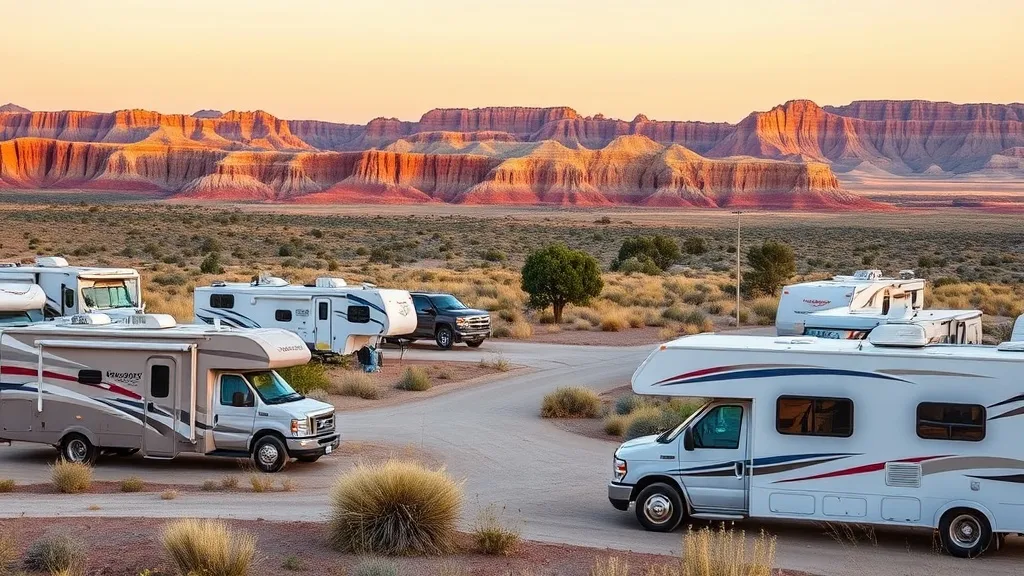
The Badlands are one of the most surreal landscapes in North America — a 60-mile wall of banded buttes, spires, and gullies eroding out of the South Dakota prairie, full of fossil beds, bighorn sheep, prairie dogs, and bison. At dawn and dusk the rock turns gold and rose, and after dark the sky is among the darkest you’ll find anywhere in the country. For RVers it’s an unforgettable stop. It is also, in camping terms, a thin market — so the planning question isn’t “which of dozens of parks?” but “which of a handful, and for how long?”
Be realistic about two things before you go. First, shade and water are scarce and heat is real: this is exposed prairie, and midsummer afternoons routinely climb past 90 or even 100 degrees with no trees to hide under. The ability to run air conditioning on an electric site is not a luxury here. Second, there are no full hookups inside the park — Cedar Pass offers electric at best. With those caveats, the Badlands reward RVers who come prepared and treat it as a one or two-night highlight rather than a week-long base.
Two practical notes before the campgrounds. Entry costs $30 per private vehicle for seven days ($25 motorcycle, $15 per person on foot or bike, $55 for a Badlands annual pass) — and the park does not accept cash at any of its three entrance stations, so bring a card. And campfires are prohibited at Cedar Pass to protect the prairie grassland; propane grills are allowed, which makes a propane fire pit or camp stove the only realistic way to cook outside.
This guide is the Badlands companion to our South Dakota RV parks flagship and our Black Hills coverage; most travelers pair a Badlands night with a longer Black Hills stay an hour and a half west. For everything in the area, see the Badlands hub.
Cedar Pass Campground (Inside the Park)
The park’s main campground sits beside the Ben Reifel Visitor Center near the Badlands Loop Road, with the buttes rising right behind the sites — you’re sleeping in the scenery. It has 96 sites, 22 of them with electric hookups (30 and 50-amp), the rest non-electric, plus two ADA-accessible sites. The sites sit on flat, open grassland arranged in loops, with the formations on the horizon; this is an open, treeless layout, not a wooded campground, so each site’s picnic-table shade shelter matters more than it sounds. There are flush toilets, potable water, a complimentary dump station in the group loop, and coin-op showers in summer at the adjacent Cedar Pass Lodge. The lodge also runs a restaurant and a small store, so you’re not far from a hot meal.
Cedar Pass is the obvious choice if you want to be inside the park for sunrise, sunset, and the night sky — and the electric sites are worth booking specifically for the air conditioning in summer. The 2026 season runs roughly late March (around March 27) through mid-October (around October 19), longer than most people expect.
- Hookups: Electric (30/50-amp) on 22 sites; rest non-electric; no sewer at the pad
- Sites: 96 total (22 electric, 2 ADA), open grassland loops
- Cost: ~$37 non-electric, ~$47 electric (2026, approximate — confirm at booking)
- Max RV length: Up to ~40 ft
- Reservations: recreation.gov (concessioner); open roughly late March–mid-October
- Best for: Being inside the park for sunset and dark skies, with A/C on the electric loop
Field tip: Electric sites are a small, fixed pool of 22 and they go first for summer weekends. If you can only get a non-electric site in July, request one on the eastern edge of the loop where the afternoon sun angle and any breeze are slightly kinder, and plan to be out hiking during the worst midday heat.
Field tip: Book one of the 22 electric sites if you’re here June through August. The difference between a non-electric and an electric site on a 100-degree Badlands afternoon is the difference between enduring the stop and enjoying it.
Badlands / White River KOA (Interior)
About four miles south of the park near Interior, this KOA Holiday is the full-hookup option the park itself can’t offer. It sits in a quiet rural setting with — remarkably for the area — hundreds of mature shade trees along the White River, plus a seasonal pool, mini-golf, a dog park, a well-stocked store, and free morning pancakes. Full-hookup pull-throughs with 50/30/20-amp service make it genuinely big-rig friendly (some pull-throughs are advertised at up to ~120 feet), and it’s the comfortable choice if you want sewer, a pool, and shade after a hot day among the formations. The season runs roughly late April through mid-October.
- Hookups: Full (50/30/20-amp, water + sewer)
- Sites: Full-hookup pull-throughs, plus tent sites, cabins, and tepees
- Cost: Approx. $56–67/night for full-hookup RV sites; tents ~$32–38 (2026, confirm at booking)
- Max RV length: Big-rig friendly; long pull-throughs available
- Reservations: Direct via KOA
- Best for: Full hookups, shade, a pool, and family amenities four miles from the park
Sage Creek Campground (Free, Inside the Park)
The park’s second campground is the polar opposite of Cedar Pass: Sage Creek is a free, first-come, first-served primitive campground with about 22 sites in the remote western Sage Creek Wilderness area, reached via the unpaved Sage Creek Rim Road off the Loop Road. There are covered picnic tables and pit toilets but no water, no hookups, and no dump station — come fully self-contained. The payoff is solitude, enormous dark skies, and wildlife that walks right through camp: bison frequently wander among the sites, and pronghorn, prairie dogs, and coyotes are common (give the bison a very wide berth — they are wild and dangerous).
The catch for RVers is access. Sage Creek Rim Road is a roughly 6.5-mile gravel road that can close after winter storms or heavy rain, and the campground itself is reached over rough surface with tight turns and a low-weight-limit bridge. The Park Service recommends keeping vehicles to about 18 feet or shorter, which rules out most trailers and big motorhomes. This is a spot for vans, truck campers, and small Class C or B rigs willing to drive slow gravel — not a big-rig destination.
- Hookups: None — no water, no toilets beyond pit, fully self-contained
- Sites: ~22 primitive, first-come, first-served
- Cost: Free
- Max RV length: ~18 ft recommended; gravel access, bridge weight limit
- Reservations: None
- Best for: Self-contained small rigs wanting free, remote camping with bison and dark skies
Field tip: Check road status at the visitor center before committing to Sage Creek, especially in spring or after rain — the rim road turns to slick gumbo when wet and can strand a rig. If the road is iffy and you want free camping, the firmer-access Nomad View option below is the safer bet.
Nomad View Dispersed Camping (Buffalo Gap National Grassland)
For boondockers, Nomad View on Buffalo Gap National Grassland is a well-known free dispersed area on a ridge overlooking the Badlands, about six miles south of Wall near the Pinnacles Entrance. There are around 20 designated gravel sites set back from the cliff (recent rules moved camping to the inland side of the road). No permits, reservations, or fees — and no water, toilets, or hookups. Cell coverage is reportedly good across the major carriers, which makes it popular with remote workers, but the access road is rough gravel and high winds are common, so stake everything down and arrive self-sufficient.
- Hookups: None — fully self-contained, no water or toilets
- Sites: ~20 designated gravel dispersed sites
- Cost: Free
- Max RV length: Open sites; high-clearance access recommended
- Reservations: None (first-come, dispersed)
- Best for: Self-contained boondockers wanting free, dramatic ridge-top camping
Renting an RV for this trip? Compare rigs, prices, and pickup locations on RVshare and Outdoorsy — both let you filter by rig size, dates, and location.
More full-hookup options nearby
The KOA isn’t the only private full-hookup park within easy reach, which is good news when it’s booked out on a summer weekend.
Badlands Hotel & Campground (Interior). The closest full-service option to the park — about a mile from the entrance near Interior — with roughly 80 level gravel pull-throughs, full hookups including 30/50-amp service, a pool, store, restaurant, and Wi-Fi. Typically open May through September. Best for travelers who want full hookups and the shortest possible drive to the Loop Road.
- Hookups: Full (30/50-amp, water + sewer)
- Sites: ~80 level gravel pull-throughs, plus tent and cabin options
- Cost: Approx. $45–70/night (2026, confirm at booking)
- Max RV length: Big-rig friendly pull-throughs
- Reservations: Direct
- Best for: Full hookups one mile from the park entrance
Sleepy Hollow Campground & RV Park (Wall). In the town of Wall, about 8 miles from the park’s Pinnacles Entrance and steps from Wall Drug, with roughly 59 full-hookup pull-through RV sites plus tent sites and cabins. Open roughly May through mid-October. Best for RVers who want town conveniences — groceries, fuel, restaurants — and an easy I-90 on/off.
- Hookups: Full (30/50-amp, water + sewer)
- Sites: ~59 full-hookup pull-throughs, plus tents and cabins
- Cost: Approx. $45–65/night (2026, confirm at booking)
- Max RV length: Big-rig friendly pull-throughs
- Reservations: Direct
- Best for: Town amenities, fuel, and Wall Drug, with easy interstate access
Comparison: Badlands-Area RV Camping
| Site | Region | Cost/night | Hookups | Max length | Reservations |
|---|---|---|---|---|---|
| Cedar Pass Campground | Badlands (in park) | ~$37–47 | Electric/none | ~40 ft | recreation.gov |
| Sage Creek (in park) | Badlands (in park) | Free | None | ~18 ft | None |
| Badlands / White River KOA | Interior | ~$56–67 | Full 30/50 | Big rig | KOA direct |
| Badlands Hotel & Campground | Interior | ~$45–70 | Full 30/50 | Big rig | Direct |
| Sleepy Hollow Campground | Wall | ~$45–65 | Full 30/50 | Big rig | Direct |
| Nomad View (dispersed) | Buffalo Gap NG | Free | None | Open | None |
Prices are approximate 2026 figures; confirm at booking.
Planning Your Badlands RV Stop
When to go and the heat
Late spring and early fall (May–June, September) are far more comfortable than the heart of summer, when the prairie bakes past 90–100 degrees with no shade. If you must come in July or August, prioritize an electric site at Cedar Pass for air conditioning, and plan your hikes and the Loop Road drive for early morning and evening — which happen to be the best light anyway. Cedar Pass operates roughly late March through mid-October; the KOA and the in-town parks follow a similar warm-season pattern, while Sage Creek and Nomad View are accessible whenever their gravel roads are dry.
Heat is only half the weather story. The Badlands sit in open prairie with little to break the wind, and afternoon thunderstorms can build fast in summer — bringing lightning, hail, and gusts that batter an awning or a soft-sided rig. The same exposure makes the area prone to sudden temperature swings: a 95-degree afternoon can drop into the 50s overnight. Retract awnings when you leave the rig, watch the radar in summer afternoons, and carry far more water than you think you need; there is no natural shade and dehydration creeps up quickly on the trails. In spring and after rain, unpaved roads (Sage Creek Rim Road especially) turn to slick, impassable gumbo — check conditions before heading off pavement.
How long, and how to fit it into the trip
Treat the Badlands as a one or two-night highlight, not a base. Most RVers slot it as a stop on the I-90 run to or from the Black Hills (about 75–90 minutes between Rapid City and the park), or as a long day trip from a Black Hills resort. The Badlands Loop Road (SD-240) is a paved, two-lane, RV-friendly scenic byway that runs roughly 27 miles connecting the Northeast and Pinnacles (Interior) entrances and threads past most of the major overlooks — easy in a motorhome, though it includes a few steep grades and reduced-speed sections, so take it slow with a big rig.
If you only have a few hours, hit these stops along the Loop Road, west to east-ish:
- Pinnacles Overlook — the high point of the north unit with sweeping south-facing views; a prime sunset spot and a reliable place to see bighorn sheep on the rocks.
- Yellow Mounds Overlook — the surreal yellow, pink, and purple paleosol layers; the most colorful pullout in the park.
- Panorama Point and the Burns Basin/Bigfoot Pass area — classic wide badlands vistas with easy pullouts.
- The Door, Window, and Notch trails — short hikes from a shared trailhead near the Northeast end, the best quick way to walk into the formations (Notch involves a ladder and a drop-off, so skip it in the worst heat).
- Big Badlands Overlook — the dramatic first or last view near the Northeast Entrance.
Most overlooks have pullouts that accommodate RVs, but a few are tight; if you’re towing, scout before committing to a small lot.
Reservations, water, and dark skies
Cedar Pass books on recreation.gov; the electric sites and summer weekends go first, so reserve ahead. The private parks book directly. Come with full fresh water and an eye on conservation — water is limited and there’s no sewer at the pad inside the park; use the complimentary dump station at Cedar Pass on the way out.
For supplies and services, the two gateway towns split the duties. Wall, about 8 miles north near the Pinnacles Entrance and right on I-90, is the practical resupply: groceries, fuel, restaurants, and the famous Wall Drug for a coffee-and-kitsch break. Interior, just south of the Northeast/Interior side, is tiny — a small store and a couple of services — but it’s the closest community to Cedar Pass and the KOA. Fuel up in Wall or Rapid City rather than counting on Interior, and know that the nearest full-service supermarket and RV parts are back in Rapid City.
Finally, don’t sleep through the night sky: the Badlands hold some of the darkest skies in the country, and the park runs evening astronomy programs in summer at the Cedar Pass amphitheater. Step outside the rig after midnight on a clear, moonless night — it’s the kind of sky most people never see.
More South Dakota RV Guides
- Up to the flagship: Best RV parks in South Dakota
- Sibling guides: Black Hills & Mount Rushmore RV parks · Custer State Park RV camping
- Region hubs: Badlands · Black Hills
- Browse: All South Dakota camping
Frequently asked questions
Can you camp in an RV inside Badlands National Park?
Yes, at Cedar Pass Campground near the Ben Reifel Visitor Center. It has 96 sites including 22 with electric hookups, takes RVs up to about 40 feet, and books through recreation.gov. There are no full hookups anywhere in the park.
Does Cedar Pass Campground have hookups?
Only electric, on 22 of its 96 sites (30 and 50-amp). The rest are non-electric. There's potable water, flush toilets, a dollar dump station, and pay showers nearby at Cedar Pass Lodge, but no sewer at the pad.
Where can you boondock near the Badlands?
Nomad View on Buffalo Gap National Grassland, about six miles south of Wall near the Pinnacles Entrance, offers free dispersed camping on a ridge overlooking the formations. There's no water or toilets, the access road is rough gravel, and winds can be fierce.
How hot does the Badlands get for RV camping?
Very hot in midsummer — the prairie regularly tops 90 to 100 degrees in July with almost no natural shade. Electric sites at Cedar Pass let you run air conditioning, which is a real consideration. Spring and fall are far more comfortable.
Is the Badlands worth a stop with a big rig?
Yes, but plan it as a one or two-night stop rather than a long base. Cedar Pass and the White River KOA handle rigs up to around 40 feet and big rigs respectively, and the Badlands Loop Road is RV-friendly. Camping options are limited, so book ahead.
Can you camp for free inside Badlands National Park?
Yes. Sage Creek Campground is a free, first-come, first-served primitive campground in the park's western Sage Creek Wilderness, with pit toilets and covered tables but no water or hookups. Bison wander through camp. Access is via an unpaved rim road that can close in wet weather, and the Park Service recommends vehicles of about 18 feet or shorter, so it suits vans and small rigs rather than big trailers.
How much does it cost to enter Badlands National Park?
A private vehicle pass is $30 and covers seven days. Motorcycles are $25 for seven days, admitting up to two motorcycles with four total passengers, and the per-person rate for hikers and cyclists aged 16 and over is $15. A Badlands annual pass is $55. One practical detail that catches people out: the park does not accept cash at any of its three entrance stations — bring a card.
What are the best stops on the Badlands Loop Road for RVers?
The paved Badlands Loop Road (SD-240) runs about 27 miles past most overlooks. Highlights include Pinnacles Overlook for sunset and bighorn sheep, Yellow Mounds Overlook for its colorful layers, Panorama Point for wide vistas, and Big Badlands Overlook near the Northeast Entrance. The short Door, Window, and Notch trails share a trailhead and let you walk into the formations. Most pullouts fit RVs, though a few are tight for big rigs.
About the author
Marisol ReyesCamping & Outdoors Editor
Marisol spent six years as an interpretive ranger in the California and Colorado state park systems before turning to writing full-time. She knows public-land camping from the inside — how reservation windows really work, why some loops fill before others, and which 'first-come, first-served' sites are worth gambling on.
More from Marisol →Campgrounds in this guide
Facts pages for each park — hookups, rig limits, rates and booking, plus every guide that covers it.
Keep reading
Black Hills RV Parks: Where to Camp Near Mount Rushmore
The best Black Hills RV parks near Mount Rushmore — Palmer Gulch, Hart Ranch, Rushmore Shadows, Rafter J, Elk Creek and more — with honest specs and real rates.
Best RV Parks in South Dakota: Black Hills, Badlands & Beyond
The best RV parks in South Dakota — from Mount Rushmore-area resorts to Badlands dark-sky camping — with honest specs, real rates, and the planning details that matter.
Custer State Park Camping: Campgrounds, Fees & RV Guide
Compare Custer State Park camping fees, eight regular campgrounds, electric sites, RV fit, one-year reservations, Center Lake same-day booking, and tunnel routes.