Grand Canyon RV Camping: South Rim, North Rim & Everything Between
RV camping at the Grand Canyon in 2026 — Mather vs Trailer Village, the post-fire North Rim with no water or hookups, gateway-town full hookups, and the new $100 non-resident fee.

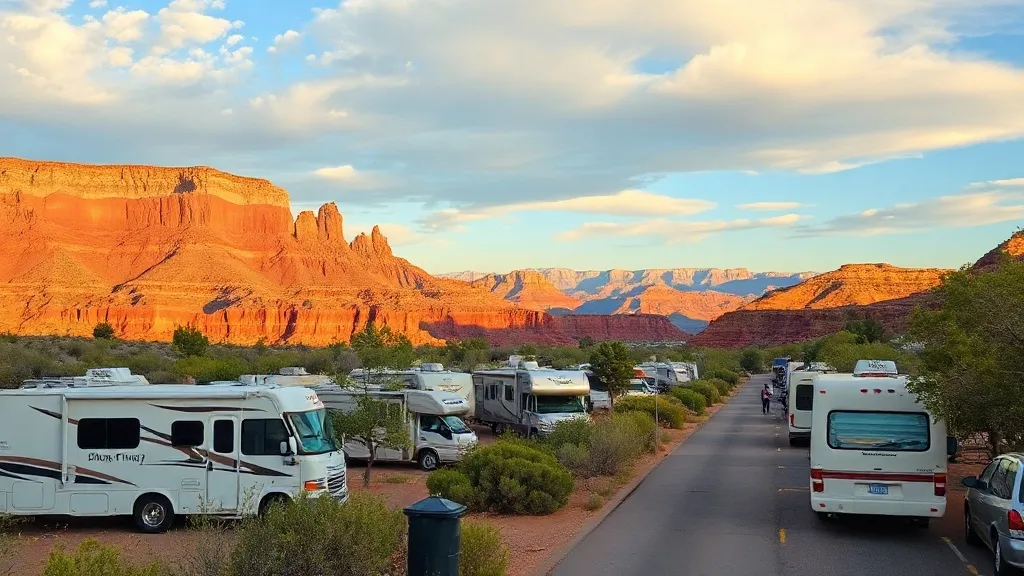
The short version: Trailer Village is the only full-hookup campground inside the park (closed since August 31, 2026 after a water-line break, with reopening projected around Thanksgiving), Mather is the better dry campground, and the gateway towns of Tusayan, Williams, and Flagstaff solve the hookup problem if both fill. Two things changed for 2026 and neither is optional reading. The North Rim reopened after the Dragon Bravo Fire but has no water and no hookups, and non-U.S. residents now pay $100 per person on top of the entrance fee. One thing that has not changed, despite what a lot of trip-planning content says: Grand Canyon has no timed entry reservation. You do not need one.
The Grand Canyon is a mile deep, up to 18 miles wide, and 277 river miles long. Those numbers register intellectually until you stand at the rim and your brain fails to process the scale. There’s no photograph that captures it. No drone footage. You have to be there, and the best way to be there — unhurried, on your own schedule, waking up to that cold pine-scented air at 7,000 feet — is in your RV.
But the Grand Canyon is really two parks separated by a chasm. The South Rim, open year-round and visited by roughly 90% of the park’s 6 million annual visitors, is the accessible, well-serviced side with two campgrounds, a full village, shuttle routes, and the only hookup sites on the rim. The North Rim, sitting 1,000 feet higher at over 8,000 feet, is open roughly five months a year, has a single campground, and feels like a completely different park — one still rebuilding after the 2025 Dragon Bravo Fire. The drive between them is 215 miles and takes four to five hours — you cannot cross the canyon by vehicle. The canyon is just one stop in our guide to the best RV parks in Arizona, which covers the whole state region by region.
This guide covers both rims, the gateway towns that solve the hookup and availability problem, and the planning details that matter. Fees, seasons, and North Rim status were re-verified against NPS and recreation.gov sources in August 2026.
For the broader Arizona picture, including snowbird parks and desert destinations, see our complete Arizona RV parks guide and the Arizona state page.
South Rim Campgrounds
The South Rim is where most Grand Canyon camping happens, and for good reason. It’s open twelve months a year, served by the park’s free shuttle system, and has the infrastructure — visitor center, general store, restaurants, medical clinic — that makes extended stays comfortable. Three campgrounds operate on the South Rim, each with a distinct character and trade-off.
Mather Campground — The Big One
Mather is the primary campground at the Grand Canyon’s South Rim, and at 319 sites it’s large enough to absorb significant demand. It sits in a ponderosa pine forest within Grand Canyon Village, roughly a mile from the rim and a short walk or shuttle ride to Mather Point, the Visitor Center, and the village commercial district. The setting is forest campground rather than canyon views — you won’t see the canyon from your site, but you’re surrounded by mature pines at 7,000 feet elevation.
The critical fact for RVers: Mather has no hookups. No electric, no water, no sewer at the site. This is NPS dry camping in a national park — generator-dependent or battery-powered. If you need shore power to run your air conditioning, Mather is not the answer. But if you’re self-contained with decent battery capacity, the campground is genuinely excellent. Sites are well-spaced by NPS standards, many are pull-through, and the ponderosa pines provide real shade and privacy.
The campground has flush toilets, potable water spigots, and a dump station. A coin-operated laundry and showers are available at the nearby Camper Services building — a small luxury that most NPS campgrounds don’t offer. The general store in the village is walking distance for groceries, firewood, and propane.
Mather operates on reservations through recreation.gov from March 1 through November 30, with a 6-month rolling window. During the peak season (April–October), sites fill quickly — not at the frantic speed of Yosemite or Zion, but you shouldn’t wait until the last minute. December through February, Mather switches to first-come, first-served, and the campground is genuinely uncrowded. Winter at the South Rim means daytime highs in the 40s, overnight lows in the teens, and occasional snow — but the rim is stunning in winter, the crowds are gone, and a cold-weather-capable rig makes it work.
Generator hours are 6 AM–8 AM, noon–2 PM, and 6 PM–8 PM. Outside those windows, the campground is quiet.
- Hookups: None
- Sites: 319 (mix of tent, RV back-in, and RV pull-through)
- Cost: $18/night
- Season: Year-round (reservations Mar–Nov, first-come first-served Dec–Feb)
- Reservation: Recreation.gov, 6-month rolling window
- Cell signal: Usable Verizon and AT&T LTE in most of the campground; T-Mobile is weaker
- Amenities: Flush toilets, potable water, dump station, coin laundry, coin showers, fire pits, picnic tables
- Max RV: 30 feet on most sites; some pull-throughs accommodate up to 45 feet (check specific site details on recreation.gov)
- Best for: Self-contained RVers who don’t need hookups; anyone wanting the in-park experience at the best price on the rim
Trailer Village — The Only Hookups on the Rim
Closed as of August 31, 2026: an August 29 flash flood broke the South Rim water line, and NPS closed Trailer Village. On September 19 the park said it hopes to reopen to overnight guests around Thanksgiving, but that is a projection. Until then the nearest full hookups are at Grand Canyon Camper Village in Tusayan, and Mather Campground is open for dry camping. See our Trailer Village review for the latest status.
Trailer Village is the answer to the question every RVer asks: where can I get full hookups at the Grand Canyon? It’s the only campground on either rim with hookup service, and it’s managed by Xanterra (the park concessionaire), not the NPS directly. This makes it feel more like a private RV park that happens to be inside a national park — because that’s essentially what it is.
The park has approximately 80 paved pull-through sites with full hookups: 30/50-amp electric, water, and sewer. Sites can accommodate rigs up to 50 feet, which makes Trailer Village one of the few places in the national park system where a large Class A motorhome can plug in and run everything.
The trade-off is the setting. Trailer Village is functional, not scenic. Sites are close together on paved pads in a grid layout. There’s no forest canopy, limited privacy, and a parking lot aesthetic that doesn’t match the grandeur of the location. You’re paying for hookups and location, not ambiance. That said, the canyon rim is a short shuttle ride or 15-minute walk away, and the village services — restaurants, stores, the Bright Angel Trailhead — are all accessible via the shuttle.
Pricing runs approximately $60/night and varies slightly by season. Compared to Mather’s $18/night, it’s a premium — but if you need to run your AC (summer highs at the South Rim hit the 80s and low 90s, and the intense sun at 7,000 feet makes it feel hotter), or if you’re in a large rig that needs shore power, Trailer Village is the only option inside the park.
Reservations are made through Xanterra’s website or by phone, not through recreation.gov. Peak season books well in advance — two to three months out for summer weekends. Trailer Village is open year-round, though winter occupancy is much lower.
- Hookups: Full (30/50 amp, water, sewer) — the only hookup campground on either rim
- Sites: ~80 paved pull-through sites
- Cost: ~$60/night (varies by season)
- Season: Year-round
- Reservation: Xanterra (not recreation.gov)
- Cell signal: Similar to Mather — usable Verizon/AT&T
- Amenities: Full hookups at site, access to village services (store, restaurants, shuttle)
- Max RV: 50 feet
- Best for: Large rigs needing hookups, summer campers who need AC, anyone wanting full services inside the park
Desert View Campground — The Quiet Eastern Option
Desert View sits 25 miles east of Grand Canyon Village along the East Rim Drive, near the park’s east entrance and the historic Desert View Watchtower. It’s the South Rim’s smallest and most rustic campground — 50 sites, no hookups, no reservations. First-come, first-served only.
The advantages are solitude and setting. Desert View is far less crowded than the village area. The nearby watchtower offers one of the best viewpoints on the South Rim, and the campground itself sits in a pinyon-juniper woodland with a different character than Mather’s ponderosa forest. The elevation is slightly lower, and the landscape feels more open and desert-like.
The disadvantages: no hookups, no shower facilities, limited services (a small seasonal store and gas station near the watchtower), and you’re 25 miles from the village and the main shuttle system. You’ll need to drive to access most rim trail segments, the visitor center, and the Bright Angel or South Kaibab trailheads. For a day trip or a quiet overnight with a self-contained rig, Desert View is a gem. For an extended base camp, the village area makes more sense.
Desert View operates seasonally — typically mid-April through mid-October, though exact dates vary by year. Check with the NPS before planning a spring or fall visit.
- Hookups: None
- Sites: 50 (first-come, first-served only)
- Cost: $12/night
- Season: Mid-April through mid-October (approximate)
- Reservation: None — first-come, first-served
- Cell signal: Weak to nonexistent; don’t rely on it
- Amenities: Flush toilets (seasonal), potable water, fire pits, picnic tables — no showers, no dump station
- Max RV: 30 feet (road and site access limits larger rigs)
- Best for: Solitude seekers, self-contained smaller rigs, campers who want to avoid the village crowds
North Rim — A Different Park Entirely
The North Rim sits at 8,200 feet elevation, receives far more precipitation than the South Rim, and is blanketed in spruce, fir, and aspen forest. It feels like the Pacific Northwest dropped into the middle of Arizona. Only about 10% of Grand Canyon visitors make it here, partly because of the access — 215 miles and four to five hours of driving from the South Rim, or about 350 miles from Phoenix. There is no road connecting the two rims directly; you drive south to Flagstaff or Cameron, then north on Highway 89 and west on Highway 67.
The trade-off for remoteness is a quieter, more intimate experience. The canyon views from the North Rim are arguably superior — you’re looking across at the South Rim’s architecture, and the deeper canyon perspective reveals layers and temples that the South Rim angles can’t show. Bright Angel Point, a half-mile paved trail from the lodge, is one of the most spectacular viewpoints in the entire park system.
North Rim Campground — read this before you plan anything
The North Rim you may remember is not the North Rim of 2026. In July 2025 the Dragon Bravo Fire destroyed roughly 70 structures, including the historic Grand Canyon Lodge and the North Rim Visitor Center. The developed area closed for the rest of the 2025 season.
The North Rim reopened on May 15, 2026, and all paved roads inside the park are open, including Highway 67, Cape Royal Road, and Point Imperial Road. But the services that made the North Rim comfortable are largely gone for this season, and an RVer needs to plan around four specific facts:
- North Rim Campground runs June 1 to October 15, 2026, with reservations on recreation.gov and a limited number of walk-up sites. It is operated by Aramark, so fees and policies can differ from Park Service campgrounds.
- There is no water and there are no RV hookups. You must arrive with full fresh tanks or buy potable water from the General Store. This is the single biggest change from pre-fire trip plans, which assumed campground water was available.
- No overnight lodging exists anywhere on the North Rim in 2026. If you are not camping, you are staying outside the park.
- Stage 2 fire restrictions are in effect for the entire season. No campfires, no wood or charcoal fires, no charcoal grills, and no outdoor smoking except inside an enclosed vehicle. Liquid-fuel stoves and lanterns are allowed only on barren ground.
What is still running: the General Store (daily, 9 a.m. to 4 p.m., May 15 to October 15) and a 24-hour gas station that is pay-at-pump only, with diesel and unleaded. The North Kaibab Trail is open to foot traffic only — stock use is suspended — and the section between Redwall Bridge and Cottonwood Campground closes October 15, 2026 for waterline repairs.
The forest setting of spruce and aspen is intact and the canyon views are as good as they have ever been. Only about 10% of Grand Canyon visitors make it here, and this season that number will be lower still. If you are genuinely self-contained, this is the quietest the North Rim has been in decades. If you rely on campground water, buy your solution before Jacob Lake.
Cell service at the North Rim is essentially nonexistent. Download offline maps before you leave.
- Hookups: None
- Water: None at the campground — bring it or buy it at the General Store
- Season 2026: June 1 – October 15 (North Rim itself open from May 15)
- Reservation: Recreation.gov; limited walk-up sites; operated by Aramark
- Fires: Prohibited all season under Stage 2 restrictions
- Lodging: None on the North Rim in 2026
- Cell signal: Essentially none — download offline maps
- Max RV: 30 feet is the safe planning figure; verify the individual site on recreation.gov
- Best for: Fully self-contained RVers who want solitude and will carry their own water
Gateway Towns — Where the Hookups Are
If you need full hookups, hot showers, laundry, and reliable WiFi — or if the in-park campgrounds are full — the gateway towns surrounding the Grand Canyon’s South Rim are the practical solution. Three towns serve as base camps, each with a different distance and trade-off profile.
Tusayan — Right Outside the Gate
Tusayan is the closest town to the South Rim, sitting just one mile south of the park’s south entrance along Highway 64. It’s tiny — a handful of hotels, restaurants, and an IMAX theater — but it has what matters: the closest private RV parks to the canyon.
Grand Canyon Camper Village is the primary option. Full hookups (30/50-amp electric, water, sewer) on a mix of pull-through and back-in sites that accommodate rigs up to 50 feet. The park has showers, laundry, a camp store, and WiFi. Pricing runs $55–75/night depending on season and site type. The location is unbeatable for a private park — you’re a 5-minute drive or shuttle ride from the rim. The Tusayan Route/Purple Route shuttle runs between the town and Grand Canyon Visitor Center during peak season, eliminating the need to deal with the park’s limited parking.
Ten-X Campground (USFS, Kaibab National Forest) sits 4 miles south of Tusayan. It’s a forest service campground with 70 sites in a ponderosa pine setting — no hookups, but at $10/night it’s the cheapest option near the South Rim. First-come, first-served, and it rarely fills except on holiday weekends. Open May through September. Generator-friendly hours are posted at the campground.
- Grand Canyon Camper Village: Full hookups (30/50), $55–75/night, max 50ft, WiFi/showers/laundry, shuttle to park
- Ten-X Campground (USFS): No hookups, $10/night, 70 sites, first-come first-served, May–Sept, forest setting
Williams — The I-40 Hub
Williams sits 60 miles south of the South Rim on Interstate 40, the historic Route 66 corridor. It’s a full-service town with grocery stores, fuel, auto repair, hardware stores, medical facilities, and a charming downtown strip of Route 66 nostalgia. Williams is also the departure point for the Grand Canyon Railway, a restored vintage train that runs daily to the South Rim — a tourist attraction in its own right, but also a genuinely practical way to visit the canyon without driving your rig up the winding Highway 64.
Multiple private RV parks operate in and around Williams:
Grand Canyon Railway RV Park is the highest-profile option, operated by the railway company with 124 full-hookup sites (30/50 amp), a pool, hot tub, WiFi, and railway packages. Sites run $50–75/night. Paved, pull-through, big-rig-friendly up to 60 feet. The convenience of walking to the railway depot is the selling point.
Canyon Gateway RV Park and Railside RV Ranch are additional options with full hookups and competitive pricing in the $40–60/night range. Williams has enough RV park capacity that finding a site — even during peak season — is rarely a problem, unlike the limited options in Tusayan.
The 60-mile drive to the South Rim takes about an hour. That’s a real commute if you’re planning multiple days at the canyon, but Williams works well as a stopover on an I-40 road trip or a base camp for a day trip to the rim with the railway handling the transportation.
- Grand Canyon Railway RV Park: Full hookups (30/50), $50–75/night, 124 sites, max 60ft, pool/WiFi, railway packages
- Canyon Gateway RV Park: Full hookups, $40–60/night, pull-throughs available
- Railside RV Ranch: Full hookups, $40–55/night, smaller park, quieter setting
Flagstaff — Full City Services
Flagstaff is 80 miles from the South Rim, a full-scale city at 7,000 feet with a university, hospital, Costco, Walmart, and every service an RVer could need. If you’re provisioning for an extended trip, doing laundry in a real laundromat, or need a mechanic, Flagstaff is the answer. It’s also a legitimate destination in its own right — historic downtown, craft breweries, Lowell Observatory, Walnut Canyon National Monument, and easy access to Sedona and the Verde Valley.
Flagstaff KOA and Woody Mountain Campground are the two most popular RV parks, both offering full hookups and big-rig-friendly sites in a ponderosa pine setting. Pricing is reasonable for a city-adjacent park: $45–70/night depending on season. Multiple other parks and forest service campgrounds are scattered along the I-40 and I-17 corridors.
The 80-mile drive to the South Rim takes about 90 minutes. For a day trip, that’s manageable. For a week of canyon exploration, you’ll be spending a lot of time on Highway 180/64. But if the in-park and Tusayan options are full, or if you want city services between canyon days, Flagstaff is the reliable fallback.
- Flagstaff KOA: Full hookups (30/50), $45–70/night, pool, WiFi, cabins available
- Woody Mountain Campground: Full hookups, $40–60/night, forested setting, quieter than KOA
Quick Comparison: All Grand Canyon Area Campgrounds
| Campground | Location | Sites | Cost/Night | Hookups | Max RV | Season |
|---|---|---|---|---|---|---|
| Mather | South Rim (in-park) | 319 | $18 | None | 30–45ft | Year-round |
| Trailer Village | South Rim (in-park) | ~80 | ~$60 | Full 30/50 | 50ft | Year-round |
| Desert View | South Rim east (in-park) | 50 | $12 | None | 30ft | Apr–Oct |
| North Rim CG | North Rim (in-park) | — | See recreation.gov | None; no water | ~30ft | Jun 1 – Oct 15, 2026 |
| Grand Canyon Camper Village | Tusayan (1 mi from gate) | Varies | $55–75 | Full 30/50 | 50ft | Year-round |
| Ten-X (USFS) | 4 mi south of Tusayan | 70 | $10 | None | 40ft | May–Sept |
| GC Railway RV Park | Williams (60 mi) | 124 | $50–75 | Full 30/50 | 60ft | Year-round |
| Flagstaff KOA | Flagstaff (80 mi) | Varies | $45–70 | Full 30/50 | 55ft | Year-round |
Planning Your Grand Canyon RV Trip
When to Go
The South Rim is open year-round, but the experience varies dramatically by season. April through October is the traditional season — daytime highs in the 60s to 80s at the rim, with clear skies and long days ideal for hiking. Summer (June–August) brings afternoon thunderstorms and temperatures that touch the 90s. The inner canyon is brutally hot — Phantom Ranch regularly exceeds 110°F — but the rim stays manageable, especially compared to the desert floor below.
Winter at the South Rim is underrated. The rim receives about 60 inches of snow annually, and winter storms transform the canyon into something surreal — red rock dusted white, low clouds filling the canyon like a sea. Daytime temperatures hover in the 40s, nights drop to the teens. Mather Campground operates first-come, first-served, Trailer Village stays open on reservations, and crowds evaporate. You need a cold-weather rig — insulated plumbing, tank heaters, a working furnace — but winter camping at the Grand Canyon is one of the park system’s best-kept secrets.
The North Rim is closed from mid-October to mid-May, and in 2026 it carries post-fire limits on top of that: open from May 15, campground June 1 to October 15, no water, no hookups, no lodging, and no fires all season. Highway 67 closes with snow and doesn’t reopen until the road is plowed and inspected in spring. September is still the best month if you are self-contained: warm days, cool nights, aspen turning, and fewer people than July.
Entrance Fees and Parking
Grand Canyon does not have timed entry. No reservation is required to enter the park, at either rim, in any season. This trips people up because Arches, Rocky Mountain, and (until this year) Glacier have all run timed-entry systems, and a lot of trip-planning content applies that assumption to the Grand Canyon. It does not apply here — turn up with a valid entrance pass and drive in.
What did change is the fee itself. An entrance pass is valid for one to seven days and covers both the South Rim and the North Rim. Since January 1, 2026, non-U.S. residents aged 16 and over pay an additional $100 per person, unless they hold an America the Beautiful Non-Resident Annual Pass. Grand Canyon is one of eleven national parks charging that surcharge, so international visitors planning a multi-park Western trip should price the annual non-resident pass against per-park fees before arriving.
Parking at the South Rim is chronically limited. The lots near the Visitor Center and village fill by 9 AM on peak days. The shuttle system is the solution — park your rig at your campground and use the shuttles to access viewpoints and trailheads. If you’re driving in from a gateway town, the park-and-ride lot near the Visitor Center is your best bet, but arrive early.
Elevation and Weather Considerations
Both rims sit well above the surrounding desert, and the elevation catches RVers off guard.
South Rim (7,000 feet): Expect temperatures 20–30 degrees cooler than Phoenix. Afternoon thunderstorms are common June through September. Snow falls October through April. Your engine will work harder on the climb from Flagstaff or Williams, and turbocharged diesel rigs handle the grades better than naturally aspirated gas engines. If your rig has a carburetor (older models), expect reduced power at altitude.
North Rim (8,200 feet): Even cooler — summer highs in the 70s, nights in the 40s. Bring layers regardless of the calendar. The approach from Jacob Lake on Highway 67 is a beautiful drive through Kaibab National Forest, but the road is narrow and winding with no services for 44 miles. Fill your fuel tank in Jacob Lake.
Shuttle System and Getting Around
The South Rim operates four shuttle routes during peak season:
- Village Route (Blue): Loops through Grand Canyon Village connecting lodges, campgrounds, the general store, and the Visitor Center
- Kaibab Rim Route (Orange): Connects the Visitor Center to the South Kaibab Trailhead and Yaki Point
- Hermits Rest Route (Red): Runs along Hermit Road to eight canyon viewpoints — this road is closed to private vehicles March through November, so the shuttle is the only way
- Tusayan Route (Purple): Connects the town of Tusayan to the Visitor Center (peak season only)
For RVers at Mather or Trailer Village, the Village Route is your lifeline. You’ll never need to move your rig to access canyon viewpoints or trailheads. The system works well — shuttles run frequently, and the time spent riding beats the stress of finding parking in a 40-foot motorhome.
Hiking and Permits
The Grand Canyon’s signature below-rim trails — Bright Angel and South Kaibab — require no permit for day hikes. Day-hiking to Indian Garden (now Havasupai Gardens, renamed in 2023) on the Bright Angel Trail is a demanding but popular option: 9.2 miles round trip with 3,060 feet of elevation change. The South Kaibab to Cedar Ridge is a shorter, steeper alternative (3 miles round trip, 1,140 feet of elevation loss) with unobstructed views.
Overnight backcountry camping below the rim requires a permit from the NPS Backcountry Information Center. Permits for popular corridors are competitive — apply four months in advance on the 1st of the month. Mule rides to Phantom Ranch and Havasupai Gardens are booked through Xanterra, often 12+ months in advance.
The Rim Trail, a mostly paved path running 13 miles along the South Rim from Hermits Rest to the South Kaibab Trailhead, is the accessible option. Sections are wheelchair-friendly, and the trail connects to all major viewpoints. This is the hike to recommend to anyone who isn’t up for the steep below-rim trails.
Frequently Asked Questions
Is Trailer Village worth the extra money over Mather Campground?
It depends on your rig and your needs. If you need hookups — and especially if you need air conditioning in summer — Trailer Village is the only option inside the park. At roughly $60/night versus Mather’s $18, you’re paying a significant premium, but you’re getting full 30/50-amp electric, water, and sewer. If you’re self-contained with good battery capacity and don’t need AC, Mather is the better campground in every other way: better setting, more space, lower cost.
Can I drive between the South Rim and North Rim?
Yes, but it’s a 215-mile drive that takes 4–5 hours. There is no road across the canyon. You drive south to Cameron or Flagstaff, east on Highway 89, north to Jacob Lake, and west on Highway 67 to the North Rim. Most RVers visit one rim or the other, not both in a single trip, unless they have time for the long drive.
When does the North Rim open and close?
For 2026, the North Rim opened May 15 and North Rim Campground runs June 1 through October 15. In a normal year Highway 67 closes with the first significant snowfall after mid-October and reopens in mid-May once the road is plowed and inspected. Remember that this season the campground has no water and no hookups, and there is no lodging on the North Rim at all following the 2025 Dragon Bravo Fire.
Do I need a timed entry reservation?
No. Grand Canyon National Park has no timed entry system and requires no reservation to enter, at either rim. You need an entrance pass, valid one to seven days and good for both rims. Non-U.S. residents 16 and over pay an extra $100 per person as of January 1, 2026, or can use an America the Beautiful Non-Resident Annual Pass.
What’s the best gateway town for Grand Canyon RV camping?
Tusayan is the closest and most convenient — one mile from the south entrance with shuttle service into the park. Williams is the best value and a charming town in its own right, especially if you combine your visit with the Grand Canyon Railway. Flagstaff offers full city services and works best for provisioning or extended stays with day trips to the canyon.
Is there cell service at the Grand Canyon?
The South Rim has usable Verizon and AT&T coverage in the village area, including Mather and Trailer Village. T-Mobile is weaker. Gateway towns have full coverage. The North Rim has essentially no cell service — plan accordingly and download offline maps before you arrive.
Explore more Arizona RV camping options or browse our full guide collection for trip planning across the Southwest.
Frequently asked questions
Do I need a timed entry reservation for Grand Canyon National Park?
No. Grand Canyon National Park does not have timed entry, and no reservation is required to enter the park. You need an entrance pass, valid for one to seven days, which covers both the South Rim and the North Rim. This is a common point of confusion because several other Western parks do run timed-entry systems.
Is the Grand Canyon North Rim open in 2026?
Yes, but with major limitations after the July 2025 Dragon Bravo Fire destroyed about 70 structures including the historic Grand Canyon Lodge. The North Rim reopened May 15, 2026, and North Rim Campground runs June 1 to October 15. There is no water and there are no RV hookups at the campground, no overnight lodging anywhere on the North Rim this season, and Stage 2 fire restrictions ban all campfires and charcoal for the entire season.
Which Grand Canyon campground has full hookups?
Trailer Village on the South Rim is the only in-park campground with full hookups — water, sewer, and 30 and 50 amp electric. It normally runs year-round with pull-through sites up to 50 feet, but it has been closed since August 31, 2026 after a flood broke the South Rim water line; NPS hopes to reopen it around Thanksgiving. Until then, the nearest full hookups are in Tusayan. Everything else inside the park is dry camping.
How much does it cost to enter the Grand Canyon in 2026?
A standard entrance pass covers one to seven days and both rims. As of January 1, 2026, non-U.S. residents aged 16 and over pay an additional $100 per person unless they hold an America the Beautiful Non-Resident Annual Pass. Grand Canyon is one of eleven parks charging that surcharge.
What size RV fits at the Grand Canyon?
Trailer Village takes rigs up to 50 feet on paved pull-throughs. Mather Campground handles roughly 30 to 45 feet depending on the loop, Desert View caps out near 30 feet, and the North Rim Campground is best for 30 feet or less. Gateway-town parks in Williams and Flagstaff handle 55 to 60 feet comfortably.
About the author
Marisol ReyesCamping & Outdoors Editor
Marisol spent six years as an interpretive ranger in the California and Colorado state park systems before turning to writing full-time. She knows public-land camping from the inside — how reservation windows really work, why some loops fill before others, and which 'first-come, first-served' sites are worth gambling on.
More from Marisol →Keep reading
Mesa & Apache Junction RV Resorts: 12 Parks With 2026–27 Rates
The East Valley snowbird deep dive: Mesa Spirit, Viewpoint, Valle del Oro, Monte Vista, Towerpoint, Mesa Regal, Sun Life, Good Life, Val Vista Villages, the Mesa/Apache Junction KOA, Lost Dutchman State Park and Usery Mountain, with 2026–27 nightly, monthly and seasonal rates, 55+ rules and short-stay policies.
Quartzsite RV Parks: 10 Hookup Parks, La Posa LTVA and Free BLM (2026–27)
Park-by-park guide to RV camping in Quartzsite, Arizona for the 2026–27 snowbird season: full-hookup parks with verified nightly, monthly and seasonal rates, the La Posa LTVA permit, the five free 14-day BLM areas, and the January 2027 show dates.
Yuma RV Parks: 12 Best Snowbird Resorts and BLM Camps (2026–27)
Verified 2026–27 guide to RV parks in Yuma, Arizona: Sun Vista, Westwind, Fortuna de Oro, Caravan Oasis, Bonita Mesa, Villa Alameda, Cocopah Bend, Yuma Lakes, the River Front KOA, Winterhaven across the river, and BLM boondocking at Imperial Dam LTVA and Senator Wash, with nightly, monthly and seasonal rates, 55+ rules and the Los Algodones day trip.