Yosemite vs Sequoia for RV Camping: Which Park Fits Your Rig?
Yosemite vs Sequoia for RV camping, compared with current 2026 fees, campsite lengths, reservations, hookups and the safest approach for rigs over 22 feet.
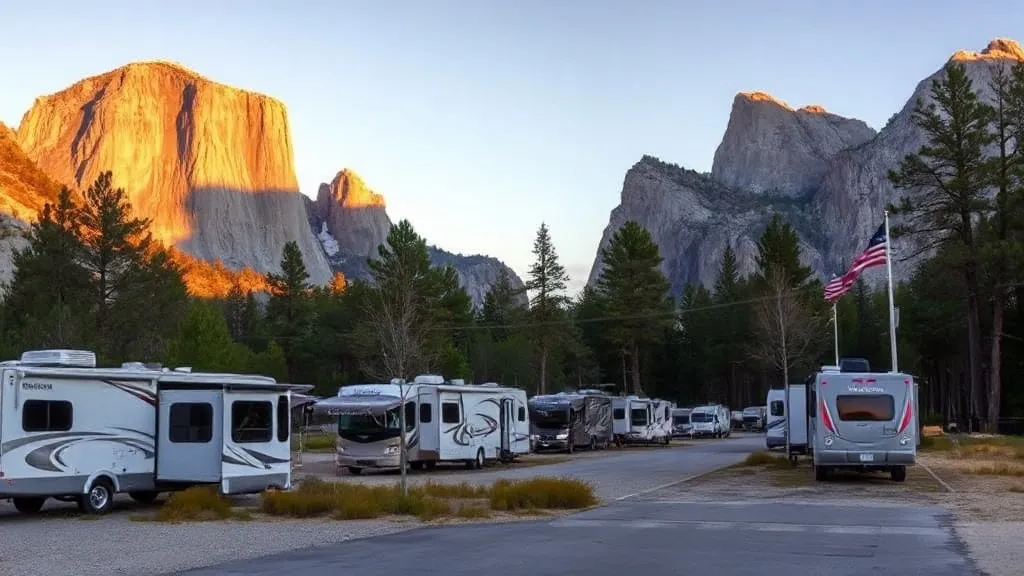
Yosemite is the better all-around RV choice for more campground inventory and more gateway hookup options. Sequoia and Kings Canyon are the better fit for giant-tree access and a quieter trip—but any vehicle over 22 feet should approach Lodgepole and Giant Forest via Highway 180, not the winding Highway 198 foothills route. Neither park has campsite hookups.
That is the practical answer. A smaller RV can make either park work, while a long combination needs to select both the campground and approach road carefully. Yosemite’s 2026 campground table has multiple sites for 35- to 40-foot motorhomes. Sequoia and Kings Canyon list fourteen campgrounds, but road geometry—not a universal park-wide RV ban—is the decisive constraint.
This is not a debate about which park is more beautiful. Yosemite Valley’s granite monoliths and Sequoia’s ancient giant trees are two entirely different spectacles, and both are worth seeing in a lifetime. This is a practical, RV-specific comparison of what it takes to actually camp at each park — the campground options, the road restrictions, the hookup situation, the gateway town infrastructure, the reservation difficulty, and the details that separate a smooth trip from a logistical mess. Both parks feature in our guide to the best RV parks in California, which is a good place to start if you are still mapping the wider trip.
We have covered both parks in depth in our dedicated guides to RV parks near Yosemite and Sequoia and Kings Canyon RV camping. This comparison is checked against the current Yosemite campground table and Sequoia & Kings Canyon camping guidance.
Quick Comparison Table
Here is how the two parks stack up across the criteria that matter most to RVers. The table gives you the overview; the sections below provide the detail behind each row.
| Criteria | Yosemite | Sequoia & Kings Canyon |
|---|---|---|
| Developed campgrounds | 12 frontcountry campgrounds plus tent-only Camp 4 in the 2026 table | 14 campgrounds listed by NPS |
| Representative RV fit | 35-ft RV/24-ft trailer at Upper Pines; 40/35 at limited Lower and North Pines sites | Site-specific; rigs over 22 ft should use Highway 180 for Lodgepole/Giant Forest |
| Full hookups inside park | None | None |
| Hookups nearby | Multiple private options across Groveland, Highway 140 and Oakhurst corridors | Private inventory is concentrated around gateway communities; quote exact dates |
| Standard in-park fee | Most RV-capable developed options are $36 in 2026 | $32 |
| Reservation pattern | Varies: five months, two months, two weeks or lottery by campground | Nearly all campgrounds require advance reservations |
| Critical road guidance | Campsite equipment length controls; roads are mountainous and seasonal | Highway 198 foothills route is not advised over 22 ft; use Highway 180 |
| Dump stations | Upper Pines year-round; Wawona and Tuolumne Meadows in summer | Verify current location and operation before arrival |
Campground Options: More Choices vs. Fewer Crowds
The first major difference is sheer camping capacity, and it tilts heavily toward Yosemite.
Yosemite: More Published RV Options, Intense Competition
The Yosemite table updated July 23, 2026 lists twelve developed frontcountry campgrounds plus tent-only Camp 4. The anchor RV campgrounds in Yosemite Valley are Upper Pines (236 sites; 35-foot RV/24-foot trailer), North Pines (81; 40/35) and Lower Pines (74; 40/35). Only eight Valley sites accommodate the largest published 40-foot RV/35-foot trailer combination, so a campground-wide maximum is not a promise of availability.
Reservation timing varies. Upper, Lower and North Pines use five-month inventory released on the 15th; North Pines also uses an early-access lottery. Wawona and Hodgdon Meadow use the five-month pattern for their main seasons, while several high-country campgrounds use two-week inventory. Tuolumne Meadows combines two-month and 14-day releases. Use the exact campground row rather than applying one booking window to the whole park.
Yosemite says campground reservations are very difficult from spring through fall. It also says sleeping overnight in an RV in a parking lot or along a road is prohibited. Treat a confirmed site as a requirement, not an optional upgrade.
Sequoia and Kings Canyon: Fourteen Campgrounds, Site-Specific Access
The current NPS overview lists fourteen campgrounds, including two that operate across all four seasons. Standard campsites cost $32 and nearly all campgrounds require advance reservations. That is materially different from the old seven-campground summary and should be checked against live operating status rather than a fixed annual list.
The parks group inventory into the Foothills, Lodgepole/Giant Forest, Mineral King, Grant Grove and Cedar Grove areas. South Fork Campground remains closed indefinitely after flood and landslide damage. Mineral King Road is narrow, winding and largely unpaved; NPS does not recommend RVs or trailers there, and does not permit them in Mineral King campgrounds.
For an RV trip, start with the selected campground’s Recreation.gov equipment record, then work backward to the entrance road. “Sequoia allows RVs” is too broad to be useful: the site may fit while the intended approach is still inappropriate for a long combination.
For the complete campground breakdown, see our Sequoia and Kings Canyon RV camping guide.
Rig Size and Road Restrictions: Where the Trip Gets Real
Both parks have road restrictions that limit RV access, but the nature of those restrictions differs in important ways. If you drive anything larger than a Class B van, read this section carefully.
Yosemite: Site Limits First
Yosemite’s published limits differ by campground and by equipment type. Upper Pines lists 35 feet for an RV and 24 for a trailer; Lower and North Pines list 40/35, but only eight Valley sites accept that largest combination. Outside the Valley, 2026 limits include 35/35 at Wawona and Crane Flat, 35/30 at Hodgdon Meadow and 35/24 at Bridalveil Creek and Tuolumne Meadows.
The park notes that RV and trailer limits differ because many sites are back-ins with limited turning radius. It may not enforce the listed length if the equipment fits the pad, but staff cannot guarantee another site if a traveler books for the wrong equipment. The safe rule is to reserve for the real configuration, not to plan around discretionary enforcement.
Seasonal road status is separate from campsite fit. Check the park’s current road page before departure, particularly for high-country travel, winter conditions and chain requirements.
Sequoia: Use Highway 180 Over 22 Feet
The critical correction is that NPS currently says vehicles over 22 feet are not advised on the winding road from the Foothills toward Giant Forest. It instructs vehicles over 22 feet to enter via Highway 180 for Lodgepole and Giant Forest. The prior version of this guide incorrectly described that guidance as a universal enforced prohibition.
That distinction does not make Highway 198 a good long-RV route. The road geometry is the reason for the warning, and planning to squeeze through because the wording is advisory is poor risk management. Route a long vehicle through the Kings Canyon entrance on Highway 180 and confirm the destination campground’s exact equipment limit.
From a suitable campsite, explore the tighter park roads in a smaller tow vehicle or towed car. This is the cleanest way to separate campground fit from sightseeing-road fit.
Here is how it breaks down by rig type:
- Under 22 feet: the most flexible category, but still verify the selected campsite and seasonal road status.
- 22–35 feet: Yosemite publishes several campground options; at Sequoia, use Highway 180 for Lodgepole/Giant Forest and check the exact site.
- Over 35 feet: only limited in-park inventory fits. Start with Recreation.gov equipment filters and expect a private gateway park to be the more dependable base.
- Long trailer combinations: use the complete combined measurement, not only the trailer box length.
This is the single most important logistical difference. Yosemite presents more published campground choices, while Sequoia makes the entrance route part of campsite selection.
Gateway Town Infrastructure: Where You Plug In
Neither park offers hookups inside its boundaries. The real decision about comfort comes down to the private parks in the gateway communities.
Yosemite: Three Approaches, Each with Full-Hookup Options
Yosemite benefits from having multiple gateway towns in different directions, each with established RV park infrastructure.
Groveland and the Highway 120 corridor provide private hookup inventory west of the park. Operators use date- and site-specific quotes, so compare the real trip dates and equipment rather than relying on a generic nightly range.
Oakhurst and Highway 41 provide a southern gateway with grocery, fuel and private RV options. This corridor can work well when Mariposa Grove and the southern park are the priority.
Mariposa and El Portal (Highway 140) offer additional options along what many consider the easiest RV route into the park. Several smaller parks line this corridor with full hookups and reasonable rates.
The combined effect is meaningful: Yosemite offers several distinct gateway corridors. Choose the corridor by the park entrance you will actually use, not by the lowest headline price.
For the complete breakdown of every gateway option, see our RV parks near Yosemite guide.
Sequoia: Three Rivers and Not Much Else
Three Rivers serves the Highway 198 foothills approach, but that is not the recommended route to Lodgepole/Giant Forest for vehicles over 22 feet. A private park here can still work if the RV remains parked while a smaller vehicle handles the mountain road.
On the Kings Canyon side, Highway 180 is the important approach for long vehicles. Compare private bases and in-park sites by the actual daily driving plan; a Central Valley address can still mean a long mountain commute.
The practical reality is that Sequoia gives you fewer private park options, less price competition, and less capacity near the park boundaries. If you need full hookups and 50-amp service, Yosemite’s gateway towns are in a different league.
Crowds, Reservation Difficulty, and the Daily Experience
Both parks are popular. But the texture of that popularity differs in ways that shape your day-to-day experience as an RVer.
Yosemite: Demand Concentrated in the Valley
Yosemite concentrates an enormous share of its demand in Yosemite Valley. On a peak-season weekend, shuttle stops, trailhead parking and the one-way road system all compete for space. That concentration is why a campsite inside the Valley has value beyond the parking pad: it reduces the need to drive in during the busiest part of the day.
The campground reservation system reflects this pressure. Upper Pines is among the most competitive campground bookings in America, and the five-month rolling window creates a recurring anxiety cycle for anyone trying to plan a summer trip.
Outside the Valley, the experience shifts dramatically. Tuolumne Meadows at 8,600 feet is quieter, cooler, and less developed. Wawona on the south end feels like a different park entirely. And the Tioga Road corridor opens up high-country scenery that most Valley-fixated visitors never see. If you are willing to camp outside the Valley, Yosemite’s crowd pressure drops significantly.
The saving grace for RV campers is that most Valley visitors are day-trippers. By 6 PM, the parking lots empty and the Valley takes on a different character — quieter, golden-lit, with deer grazing near the campground loops and the Merced River running cold. Morning and evening in the Valley belong to the campers, and that alone justifies the reservation battle.
Sequoia: A More Distributed Experience
Sequoia and Kings Canyon spread visitors across the Foothills, Giant Forest, Grant Grove and Cedar Grove areas. General Sherman and Giant Forest can still be busy, but the experience is less concentrated than a Yosemite Valley itinerary.
Do not translate that into guaranteed campground availability. NPS says nearly all Sequoia and Kings Canyon campgrounds require advance reservations and fill quickly. Compare live inventory for the exact area and rig instead of assuming a universal one-month release or an easier walk-up option.
Kings Canyon, the northern section of the combined parks, is particularly undervisited. Cedar Grove, deep in the canyon along the Kings River, draws a fraction of the traffic that the sequoia groves receive. If solitude and quiet campgrounds matter to you more than proximity to the biggest trees, the Kings Canyon side of the parks delivers a fundamentally different experience than anything at Yosemite.
Scenery and Activities: Granite Walls vs. Giant Trees
Both parks are in the Sierra Nevada, but they showcase entirely different landscapes.
Yosemite: Granite, Waterfalls, and the Most Photographed Valley in America
Yosemite Valley is a glacier-carved cathedral. El Capitan rises 3,000 feet from the Valley floor as a sheer granite face. Half Dome’s distinctive profile is one of the most recognizable landmarks in the national park system. Yosemite Falls drops 2,425 feet in three cascades — the tallest waterfall in North America, running at full power in May and June from Sierra snowmelt.
The park’s appeal extends beyond the Valley. Tuolumne Meadows offers subalpine meadows, granite domes, and access to the High Sierra backcountry. Mariposa Grove in the park’s southern section contains over 500 mature giant sequoias — a preview of what Sequoia National Park offers at a much larger scale. Glacier Point provides a panoramic overlook of the Valley, Half Dome, and the High Sierra that is accessible by car (when the road is open, typically May through October).
For RV campers, the daily rhythm at Yosemite involves driving or shuttling into the Valley for sightseeing and hiking, then returning to camp in the evening. The signature hikes — Mist Trail to Vernal and Nevada Falls, the Half Dome cables route, the Valley Loop Trail — all start from the Valley floor. If you are based at a gateway town park, budget 30-60 minutes each way for the drive in and out.
Sequoia: The Biggest Trees on Earth and a Deep Canyon
Sequoia’s headliner is biological rather than geological. The giant sequoia groves — particularly the Giant Forest, which contains five of the ten largest trees on Earth — deliver an experience that is genuinely humbling in a way that photographs cannot convey. Standing at the base of General Sherman, which is 275 feet tall and 36 feet in diameter at the base, recalibrates your sense of scale. These trees were saplings during the Bronze Age.
Kings Canyon adds geological drama to the equation. The canyon carved by the Kings River is over 8,000 feet deep at its maximum — deeper than the Grand Canyon in places. The drive on Highway 180 into Cedar Grove descends through dramatic granite walls to the canyon floor, where the Kings River runs clear and cold through groves of incense cedar and black oak.
The hiking is excellent but different from Yosemite. The Congress Trail loop through the Giant Forest is a gentle walk among the largest trees. Moro Rock, a 400-step granite staircase, provides a panoramic view of the Great Western Divide. For more serious hikers, the Rae Lakes Loop and the High Sierra Trail into the backcountry are multi-day routes that rank among the best in California.
The activities at Sequoia skew quieter than Yosemite. There is no equivalent of the Valley’s commercial infrastructure — no gift shops clustered around every attraction, no shuttle bus crowds at every stop. The tradeoff is less convenience and fewer dining options, but for campers who value a slower pace, Sequoia delivers.
Best Season for Each Park
Yosemite
The broad RV camping window is May through October, but each campground publishes its own 2026 season. Upper Pines is the year-round Valley RV campground; Lower and North Pines are seasonal. High-country opening dates depend on snow, road access, staffing and water systems, so use the live NPS table rather than last year’s calendar.
Sequoia
The broad high-elevation window is also late spring through fall, while NPS lists two campgrounds as operating in all four seasons. Conditions differ sharply between the hot, dry Foothills and the 6,700-foot Lodgepole area. Check operating dates, fire restrictions and road status together; an open campsite does not make every sightseeing road suitable for the RV.
Who Should Choose Yosemite
Yosemite is the better choice if you:
- Drive a mid-sized rig (25–35 ft motorhome). Yosemite publishes several in-park options for this range. Exact site fit still controls, but there are more clearly documented choices than at the top end of Sequoia’s inventory.
- Want full-hookup options near the park. Yosemite’s three gateway corridors (Groveland, Mariposa/El Portal, Oakhurst) offer five or more full-hookup parks with 50-amp service, pull-throughs, and competitive pricing. The variety and capacity are significantly better than what exists near Sequoia.
- Prioritize dramatic scenery and bucket-list landmarks. Yosemite Valley is one of the most visually stunning places on the continent. El Capitan, Half Dome, Yosemite Falls, and Glacier Point are icons for a reason. If this is your first Sierra Nevada trip, Yosemite delivers the bigger visual payoff.
- Want more activities and infrastructure. Yosemite has a more developed visitor infrastructure — shuttle systems, restaurants in the Valley, ranger programs, equipment rental. If you want a national park experience with some built-in convenience, Yosemite provides it.
- Are waterfall-obsessed. Visit in late May or June and Yosemite’s waterfalls are at peak flow. There is nothing comparable at Sequoia.
For the full breakdown of where to stay, see our RV parks near Yosemite guide.
Who Should Choose Sequoia
Sequoia is the better choice if you:
- Drive a small rig (under 22 ft). Smaller equipment gives you more route and campsite flexibility, although individual campground rules still apply.
- Can route a longer rig through Highway 180. NPS specifically directs vehicles over 22 feet to this approach for Lodgepole and Giant Forest. Confirm the selected campsite before committing to the route.
- Want a less concentrated trip. Sequoia and Kings Canyon distribute attractions across several areas instead of funneling nearly every first visit into one valley.
- Want to see the largest trees on Earth. Mariposa Grove in Yosemite has giant sequoias, but Sequoia National Park has the Giant Forest — the most concentrated collection of massive sequoias anywhere. General Sherman alone is worth the trip. This is a once-in-a-lifetime natural spectacle.
- Prefer a less commercial atmosphere. Sequoia feels wilder and less developed than Yosemite. There are fewer visitor services, fewer gift shops, and fewer crowds between you and the trees. For campers who want to feel like they are in a wilderness rather than a tourism operation, Sequoia delivers.
- Are budget-conscious inside the park. The standard Sequoia and Kings Canyon campsite fee is $32 versus $36 at Yosemite’s main RV-capable campgrounds. Private operators use live quotes, so compare the total for the actual dates.
- Want a four-season option. NPS lists two campgrounds as operating in all four seasons, weather and road conditions permitting.
For the full campground guide, read our Sequoia and Kings Canyon RV camping guide.
Can You Visit Both Parks in One Trip?
Yes, and this is actually more practical than combining most national park pairs. Yosemite and Sequoia are separated by roughly 200 miles of driving — about 4 to 5 hours via Highway 41 south to Fresno and Highway 180 east to Kings Canyon, or a longer but more scenic route through the Sierra foothills. That is a manageable travel day in an RV, unlike the 8-9 hour haul between Yellowstone and Glacier.
A practical two-week itinerary is five or six days at Yosemite, a Central Valley resupply day, then four or five days in Sequoia and Kings Canyon. If the combination exceeds 22 feet, approach the Sequoia portion via Highway 180 and use a smaller vehicle for tighter sightseeing roads.
The route also passes through Fresno, which has big-box stores, RV service centers, and propane refills — a practical resupply stop between the two parks.
If you are continuing south after Sequoia, the route connects naturally to the Eastern Sierra via Highway 198 to 395, putting you in range of Alabama Hills near Lone Pine, one of the best free camping spots in California. For the broader California picture, see our California RV trip planner.
The Bottom Line
Yosemite is the more famous park, the more photographed park, and the park with better RV infrastructure in its gateway towns. It accommodates mid-sized rigs inside the park, offers more campground options, and delivers bucket-list scenery that justifies its reputation. It is also more crowded, more expensive, and more stressful to book than almost anywhere else in the national park system. If you want the iconic Sierra Nevada experience and you are prepared to fight the reservation system, Yosemite earns the effort.
Sequoia is the quieter, less commercial alternative that trades Yosemite’s granite icons for giant trees and a more distributed park. A long rig requires more deliberate route planning: use Highway 180 for Lodgepole and Giant Forest, then let the exact campsite record determine fit. If you value ancient forests over waterfalls and famous Valley landmarks, Sequoia is the better fit.
Neither choice is wrong. But the right choice depends on your rig size, your tolerance for crowds, and whether you came to the Sierra Nevada to see the most famous valley in America or to stand at the base of the largest living things on Earth. Now you have the information to decide.
Frequently asked questions
Is Yosemite or Sequoia better for RV camping?
Yosemite is usually easier for RVers who want more in-park choices and multiple full-hookup gateway corridors. Sequoia and Kings Canyon suit travelers prioritizing giant sequoias and a quieter trip, but rigs over 22 feet should use Highway 180 rather than the winding Highway 198 approach.
Do Yosemite or Sequoia campgrounds have RV hookups?
No. Neither park provides campsite hookups. Yosemite has dump stations at Upper Pines year-round and near Wawona and Tuolumne Meadows in summer; use a private gateway RV park if hookups are essential.
Can an RV over 22 feet enter Sequoia National Park?
Yes, but NPS advises vehicles over 22 feet to enter via Highway 180 for Lodgepole and Giant Forest. The winding Generals Highway route from the Highway 198 foothills entrance is not advised for vehicles over 22 feet.
How much are campsites in Yosemite and Sequoia in 2026?
Yosemite's principal RV-capable developed campgrounds are generally $36 nightly in 2026. Sequoia and Kings Canyon list a $32 standard-campsite fee. Exact availability and the selected campsite's equipment limits still control.
About the author
Marisol ReyesCamping & Outdoors Editor
Marisol spent six years as an interpretive ranger in the California and Colorado state park systems before turning to writing full-time. She knows public-land camping from the inside — how reservation windows really work, why some loops fill before others, and which 'first-come, first-served' sites are worth gambling on.
More from Marisol →Keep reading
Beachfront RV Parks in Southern California: San Diego vs Pismo vs Ventura vs Malibu
Where to camp on the sand with an RV in Southern California — Mission Bay resorts, Pismo's beach-town parks, Ventura's oceanfront Rincon Parkway and Malibu's blufftop — compared on beach access, hookups, rates and booking.
Azalea Campground, Kings Canyon: Sites & RV Limits (2026)
A verified 2026 Azalea Campground review covering all 110 sites, the $32 fee, site 93's 47-foot RV record, 30-foot trailer limit, reservations, winter camping, and bear rules.
Tahoe Valley Campground Review: Sites, Rules & Booking (2026)
Is Tahoe Valley Campground worth it? Verified 2026 review of its 439 sites, year-round operation, live rates, paid Wi-Fi, fire rules, cancellation policy, and South Lake Tahoe trade-offs.