Monument Valley Camping & RV Parks (2026): Best Options
Compare Monument Valley camping and RV parks by hookups, rig limits, location, and current Navajo Nation rules before you reserve.
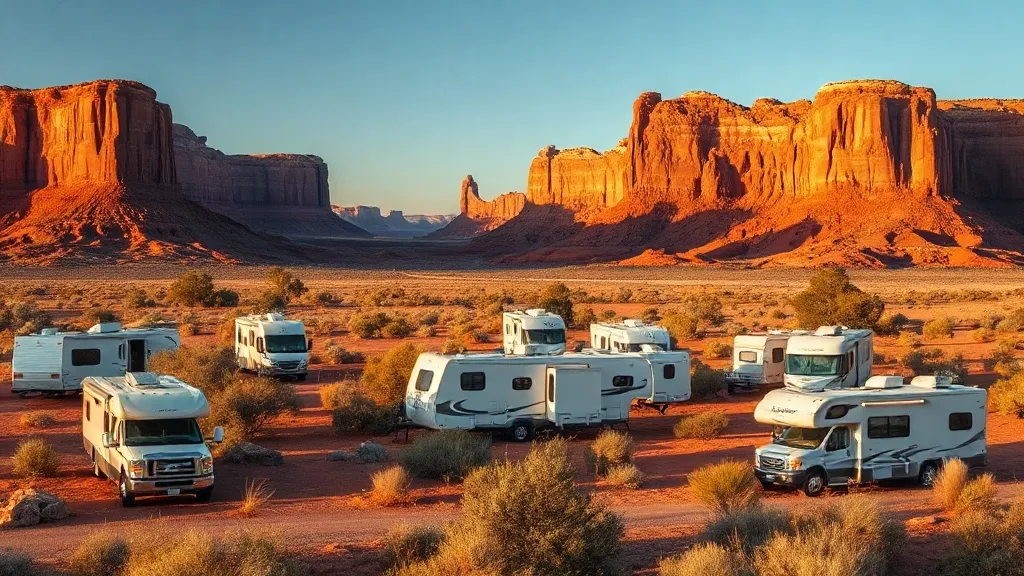
For Monument Valley camping, choose The View only if your RV is 24 feet or shorter and you can dry camp. Choose Goulding’s for full hookups and resort amenities, or Monument Valley KOA for full hookups and pull-through space up to the park’s published limits. Self-contained smaller rigs can consider BLM land at Valley of the Gods when the gravel-and-clay road is dry.
One restriction changes the entire RV plan: Navajo Nation Parks currently prohibits RVs, camper vans, motorcycles, large SUVs, and off-road vehicles on Monument Valley’s 17-mile Valley Drive. Leave the RV at camp and use an eligible smaller vehicle or book an authorized Navajo tour.
For RVers, Monument Valley requires a different kind of planning than most Utah destinations. The valley sits entirely within the Navajo Nation — the largest Native American reservation in the United States, spanning portions of Utah, Arizona, and New Mexico. This means federal land rules don’t apply. There are no BLM campgrounds within the tribal park, no dispersed camping along the roadside, and no National Park Service infrastructure. Campgrounds are Navajo-operated or Navajo-permitted, and the rules reflect tribal sovereignty and cultural values.
The official 2026 Monument Valley page lists a $10 per-person entry fee and a separate $15 Scenic Drive vehicle fee, both subject to change. The National Parks pass does not apply because this is a Navajo tribal park, not an NPS unit.
This guide compares the practical RV options using the Navajo Nation, campground, KOA, Goulding’s, and BLM pages checked in summer 2026.
For the broader Utah circuit, see our guide to RV parks near Utah’s national parks. If you’re coming from or heading to Moab — a common routing — check our Moab RV parks guide for the other end of the journey.
Quick answer: Camping in Monument Valley comes down to four choices. The View Campground is the only campground inside the tribal park, but it is dry camping with a 24-foot RV maximum. Goulding’s (about 5 miles away) and Monument Valley KOA (about 8 miles north on Highway 163) are the two RV parks with full hookups; KOA lists 50-amp service and pull-throughs to 80 feet. Free primitive camping is on BLM land at Valley of the Gods, roughly 30 miles away, and rates at the three developed campgrounds are date-specific live quotes rather than fixed public prices. Whatever you pick, RVs cannot drive the 17-mile Valley Drive.
Monument Valley campgrounds compared
| Campground | Hookups | Max RV | Distance to tribal park | Cost | Season | Reservations |
|---|---|---|---|---|---|---|
| The View Campground (Navajo) | None (restrooms, showers; no dump) | 24 ft | At the park | Live quote + park entry | Check dates | monumentvalleyview.com |
| Goulding’s RV & Campground | Full (W/E/S), cable, Wi-Fi | Verify site vs. rig | ~5 miles | Live quote | Year-round (pool closed Nov 1–Mar 30) | gouldings.com or phone |
| Monument Valley KOA Journey | Full, 30/50 amp | 75 ft listed, 80-ft pull-throughs | ~8 miles | Check koa.com | Mar 2–Oct 31 | koa.com |
| Valley of the Gods (BLM) | None, dispersed | Condition-dependent | ~30 miles | Free | Year-round, weather permitting | None |
| Sand Island (BLM) | None (vault toilets, seasonal water) | Loop B for rigs over 26 ft | ~45 miles | ~$15–20 | Year-round | First-come, first-served |
Camping on Navajo Land: What You Need to Know
Before diving into specific campgrounds, understand the context. Monument Valley Navajo Tribal Park is not a national park. It is operated by the Navajo Nation Parks and Recreation Department. The rules are different from what you may be accustomed to on federal land:
- No alcohol. The Navajo Nation prohibits alcohol on all reservation land. This is strictly enforced. Do not bring beer, wine, or spirits to any campground within the reservation.
- No drones. Drone operation is prohibited throughout the Navajo Nation without specific written permission from the Navajo Nation.
- No off-road driving. Stay on designated roads within the tribal park. The Valley Drive loop road is unpaved but maintained for passenger vehicles in dry conditions.
- Time zone note. The Navajo Nation observes Mountain Daylight Time in summer — unlike the rest of Arizona, which does not observe daylight saving time. Utah also observes MDT. So Monument Valley and Utah are on the same clock year-round, but if you’re crossing into non-reservation Arizona, you may gain or lose an hour depending on the season.
- Permits for guided tours. Exploring beyond the self-guided Valley Drive loop requires a Navajo guide. Several sections of the valley — including iconic locations like Ear of the Wind, Sun’s Eye, and the backcountry arches — are accessible only with authorized Navajo tour operators.
Respecting these rules is not optional. This is someone’s home, and the Navajo people have been generous in sharing it with visitors. Treat the land accordingly.
The View Campground — the only campground inside Monument Valley
The View Campground sits on the mesa rim directly adjacent to The View Hotel, overlooking Monument Valley from the same vantage point that has appeared in a thousand photographs. Your campsite view is, literally, the most iconic landscape panorama in the American West: the East and West Mitten Buttes and Merrick Butte rising from the valley floor, with the vast desert stretching to the horizon behind them.
At sunset, this view is transcendent. The buttes shift through orange, crimson, and deep purple as the light fades. At sunrise, the first light catches the eastern faces while the western shadows still hold the night’s blue. You are camping in a photograph.
The campground offers RV and wilderness tent sites. Every RV site is dry camping with no hookups, and the official maximum RV length is 24 feet. Campers have access to a full restroom and shower facility. The campground page does not promise a dump station, so arrive with the tanks managed.
Sites are relatively close together — this is not a spacious, spread-out campground. During peak season (April through October), the campground fills regularly, and the atmosphere is more bustling than intimate. But the view compensates for everything. When the tour buses leave and the last light hits the buttes, the campground quiets down and the sky opens up.
The View does not publish one reliable fixed campground rate on its public information page. Enter the actual dates in its booking flow and compare the checkout total. Tribal park entry is separate.
- Hookups: None
- Sites: RV and tent sites along the mesa rim
- Cost: Date-specific live quote, plus tribal park entry
- Reservation: Through Monument Valley View
- Amenities: Restrooms, showers — no hookups, no dump station
- Max RV: 24 feet
- Best for: Photographers, sunset chasers, anyone who wants to wake up to the most famous view in the American West
Goulding’s Monument Valley RV park — full hookups 5 miles out
Goulding’s is the historical anchor of Monument Valley tourism. Harry and Leone “Mike” Goulding established a trading post here in 1924, and in 1938 Harry famously drove to Hollywood with photographs of the valley, convincing John Ford to film “Stagecoach” at the location. That film launched both John Wayne’s career and Monument Valley’s place in the American imagination. The lodge, museum, campground, and RV park that exist today grew from that trading post.
The RV park sits adjacent to Goulding’s Lodge, tucked against the red rock formations on the Utah side of the state line (Monument Valley straddles Utah and Arizona). The setting is classic high-desert Southwest — red sandstone walls, sparse vegetation, and long views toward the valley’s buttes and mesas.
This is where Goulding’s distinguishes itself from The View Campground: full hookups. RV sites include water, electric, and sewer connections. After dry camping at The View or elsewhere on the reservation, pulling into a full-hookup site at Goulding’s feels like arriving at civilization.
The official page lists cable TV, Wi-Fi with no availability guarantee, bathrooms, hot showers, laundry, and an indoor pool that closes November 1 through March 30.
Goulding’s operates a shuttle service connecting the campground to the lodge, restaurant, general store, and gas station. The museum in the original trading post is worth an hour — it covers the Gouldings’ story, the John Ford film history, and Navajo culture. A gas station on the property is a genuine convenience — the next reliable fuel can be a long drive in any direction.
The location puts you about 5 miles from the Monument Valley Tribal Park entrance. Navajo-guided tours depart from the Goulding’s property, making it easy to book the backcountry excursions that access areas beyond the self-guided Valley Drive.
Rates are date-specific. Use Goulding’s official booking flow or call for a current quote rather than relying on an old guest surcharge or seasonal range.
- Hookups: Full (water, electric, sewer)
- Sites: RV sites (pull-through and back-in), tent sites
- Cost: Live quote from Goulding’s
- Max RV: Verify the assigned site against complete equipment length
- Amenities: Cable TV, WiFi, indoor pool, laundry, showers, restrooms, shuttle service, restaurant, general store, gas station, museum
- Location: ~5 miles from Monument Valley Tribal Park entrance
- Best for: RVers who need full hookups, history buffs, families, those booking Navajo-guided tours
Monument Valley KOA — RV camping with full hookups and dark skies
The Monument Valley KOA sits along Highway 163, the road that approaches Monument Valley from the north — the same road where Forrest Gump stopped running in the film, with the buttes rising in the background. The KOA is about 8 miles from the tribal park entrance, positioned between the town of Mexican Hat and the valley itself.
The official KOA page lists full-hookup RV sites, 50-amp service, pull-through inventory, restrooms, a camp store, playground, and a dog area. It publishes a maximum pull-through of 80 feet and a maximum listed equipment length of 75 feet; the booking result for the exact rig remains authoritative.
KOA also warns that remote-area Wi-Fi supports basic browsing and email rather than streaming, and that cellular signal is limited. Download maps and reservation details before arrival.
The season runs from early March through October 31. The campground has a camp store for basics.
- Hookups: Full (30/50 amp, water, sewer)
- Sites: Pull-through and other RV sites plus tent sites
- Cost: Check koa.com for current rates
- Season: March 2 through October 31
- Max RV: KOA lists up to 75 feet, with 80-foot maximum pull-throughs; verify assigned site
- Connectivity: Basic-use Wi-Fi and limited cellular service
- Amenities: Restrooms, camp store, playground, dog area
- Location: Highway 163, ~8 miles from Monument Valley Tribal Park entrance
- Best for: Stargazers, photographers, RVers who want full hookups with dark skies, those who prefer a quieter setting away from the tribal park
Valley of the Gods — free Monument Valley Utah camping on BLM land
Valley of the Gods is Monument Valley’s quieter, free, and completely uncrowded sibling. This BLM-managed area sits about 30 miles northeast of Monument Valley, accessible from Highway 163 (near Mexican Hat) or Highway 261 (near the Moki Dugway). A 17-mile unpaved loop road winds through a landscape of sandstone buttes, towers, and spires that are every bit as dramatic as the formations in the tribal park — just smaller in scale and without the entrance fees, crowds, or restrictions.
Camping is free dispersed BLM camping with no permits, no reservations, and no facilities. Standard BLM rules apply: 14-day stay limit within a 28-day period, pack out all trash, leave no trace. There are no toilets, no water, no fire rings (campfires may be restricted — check current conditions), and no services of any kind. You must be fully self-contained.
The loop road is graded gravel and clay with sharp turns and several wash crossings. BLM says it can be suitable for passenger cars when dry but tells visitors to check locally after bad weather. BLM does not publish one safe RV-length cutoff. Walk or inspect an access section before committing a long, low-clearance rig, and use a developed campground if there is any doubt.
After rain, the clay surface becomes slick and potentially impassable for any vehicle. Check conditions locally before driving in.
The camping itself is spectacular. You pull off the loop road onto established turnouts and camp with buttes and towers as your only neighbors. The silence is absolute — no generators (because there’s no one else), no traffic, no light pollution. The night sky here is among the darkest in the lower 48 states. If you’re self-contained and comfortable with primitive camping, Valley of the Gods is one of the great free camping experiences in the American West.
- Hookups: None (primitive dispersed camping)
- Sites: Informal pullouts along the 17-mile loop road
- Cost: Free
- Season: Year-round (road may be impassable after rain)
- Reservation: None
- Cell signal: None to minimal
- Amenities: None — pack in, pack out everything
- Rig fit: No universal BLM maximum; best suited to equipment that safely clears turns and washes in current conditions
- Best for: Boondockers, overlanders, photographers, solitude seekers, anyone with a self-contained rig who wants Monument Valley scenery without the crowds or fees
Sand Island Campground — The BLM Base Near Bluff
Sand Island BLM Recreation Area sits 3 miles west of Bluff, Utah, on the north bank of the San Juan River. It’s about 45 miles northeast of Monument Valley — not next door, but within reasonable day-trip distance, and it offers a developed BLM campground with amenities that Valley of the Gods lacks.
The campground has 27 sites split into two loops. Loop A accommodates vans and smaller vehicles with trailer length restrictions. Loop B is designed for larger RVs and travel trailers over 26 feet. Sites have picnic tables, fire rings, and access to vault toilets. Drinking water is available seasonally, typically March through October.
Sand Island is a first-come, first-served campground — no reservations. In spring and fall, the campground fills by mid-afternoon on weekends. Midweek availability is usually not an issue.
The campground’s standout feature is the Sand Island Petroglyph Panel — a cliff face covered in petroglyphs ranging from 300 to 3,000 years old, now listed on the National Register of Historic Places and part of Bears Ears National Monument. You can walk to the panel from your campsite. The petroglyphs include Kokopelli figures, bighorn sheep, human forms, and geometric patterns spanning multiple cultural periods. It is one of the most accessible and impressive rock art sites in the Southwest.
Sand Island is also the primary launch point for San Juan River float trips through the Goosenecks — a scenic section of deep river meanders. If you’re interested in combining an RV trip with a river experience, this is the staging area.
The town of Bluff, 3 miles east, has a small grocery store, gas station, and several surprisingly good restaurants for a town of its size. Bluff is also a gateway to the Cedar Mesa area of Bears Ears National Monument, where cliff dwellings and backcountry hiking await.
- Hookups: None
- Sites: 27 (Loop A for smaller vehicles, Loop B for larger RVs)
- Cost: ~$15–20/night
- Season: Year-round (water seasonal March–October)
- Reservation: None — first-come, first-served
- Cell signal: Usable in the Bluff area
- Amenities: Vault toilets, seasonal drinking water, picnic tables, fire rings, boat launch
- Location: 3 miles west of Bluff on Highway 191, ~45 miles from Monument Valley
- Best for: History and archaeology enthusiasts, river trip staging, those wanting a developed BLM campground near Monument Valley
Monument Valley RV parks and campgrounds at a glance
| Campground | Hookups | Sites | Cost/Night | Max RV | Distance to MV | Season |
|---|---|---|---|---|---|---|
| The View CG (Navajo) | None | RV + tent | Live quote + entry | 24 ft | At the park | Check dates |
| Goulding’s | Full | RV + tent | Contact park | Large rigs | 5 miles | Seasonal |
| Monument Valley KOA | Full, 50A | RV + tent | Check KOA | Up to 75 ft listed | 8 miles | Mar 2–Oct 31 |
| Valley of the Gods (BLM) | None | Dispersed | Free | Condition-dependent | 30 miles | Year-round* |
| Sand Island (BLM) | None | 27 | $15–20 | Large (Loop B) | 45 miles | Year-round |
*Road may be impassable after rain
Planning your Monument Valley RV camping trip
Getting There — The Approaches
Monument Valley sits in the southeast corner of Utah, far from the interstate system. Every approach involves long drives through spectacular but remote country. Plan your fuel and water accordingly.
From Moab (150 miles, ~2.5 hours): South on Highway 191 through Monticello and Blanding, then west on Highway 163 through Mexican Hat. This is the most common routing for travelers combining Monument Valley with Arches and Canyonlands. The road is well-maintained two-lane highway the entire way.
From Page/Lake Powell (130 miles, ~2.5 hours): North on Highway 89 to Kayenta, then north on Highway 163. This approach enters from the Arizona side and is the standard route for those combining Monument Valley with Grand Canyon, Antelope Canyon, or Horseshoe Bend.
From Flagstaff (180 miles, ~3 hours): North on Highway 89 through the Navajo Nation, then through Kayenta to Highway 163.
From the west (Scenic Byway 261 / Moki Dugway): If you’re coming from Natural Bridges or the Cedar Mesa area, Highway 261 descends the Moki Dugway — a series of steep, unpaved switchbacks dropping 1,100 feet off the mesa in 3 miles. Do not attempt the Moki Dugway in a large RV, towing a trailer, or in any rig you’re not confident driving on steep, gravel switchbacks with exposure. It is passable for smaller RVs and trucks, but it is not for the faint of heart.
The Valley Drive
The self-guided Valley Drive is a 17-mile dirt loop through the park. Navajo Nation Parks currently prohibits RVs, camper vans, motorcycles, large SUVs, and off-road vehicles on it because of rough terrain and deep sand. Park the camping equipment and use an eligible smaller vehicle, or take an authorized tour.
Drive time is approximately 1.5 to 3 hours depending on how many times you stop. You will stop often. Budget more time than you think.
Weather and Best Seasons
Monument Valley sits at approximately 5,500 feet in high desert. The climate is characterized by hot summers, mild springs and falls, and cold winters with occasional snow.
April through May and September through October are the prime seasons. Temperatures are comfortable (60s to 80s during the day), the light is excellent for photography, and the crowds are present but not overwhelming. These are the months when the low-angle sun creates the dramatic shadows on the buttes that define the Monument Valley aesthetic.
June through August brings daytime highs in the upper 90s and occasionally above 100. The heat is dry but intense, and shade is essentially nonexistent. Afternoon thunderstorms during monsoon season (July–September) bring dramatic cloud formations and lightning — spectacular to photograph from a safe distance, dangerous if you’re caught exposed. The storms can make the Valley Drive and Valley of the Gods road temporarily impassable.
November through March brings cold temperatures (highs in the 40s and 50s, lows in the teens and 20s) and occasional snow. Monument Valley dusted with snow is extraordinarily photogenic, and winter visitation is minimal. Goulding’s and The View Campground operate year-round, but the KOA closes for winter.
Water, Fuel, and Supplies
This is the most critical planning element for Monument Valley. The area is remote. Services are limited and spaced far apart.
Fuel: Goulding’s has a gas station. Kayenta (about 25 miles south on Highway 163) has multiple stations. Mexican Hat (about 22 miles north) has limited fuel. Bluff (about 45 miles northeast) has fuel. Do not let your tank drop below half in this area.
Water: Goulding’s RV park has water at hookups. The View Campground has restroom facilities but no RV water fill. If you’re boondocking at Valley of the Gods, fill your tanks in Mexican Hat or Bluff before heading in.
Groceries: Kayenta has a small grocery store. Bluff has a limited store. For serious provisioning, Cortez, Colorado (90 miles east) or Page, Arizona (130 miles west) are the nearest towns with full grocery stores. Stock up before you arrive.
Propane: Available at Goulding’s. Plan ahead — your furnace will run during spring and fall nights.
Dump station: Goulding’s has dump station facilities for registered guests. The KOA has dump service. If you’re dry camping at The View or boondocking at Valley of the Gods, plan your tank management carefully — the nearest public dump stations are in Bluff or Mexican Hat.
Navajo-Guided Tours
The self-guided Valley Drive shows you the “front yard” of Monument Valley. The guided tours take you into the backcountry — the “living room.” Areas like Ear of the Wind, Sun’s Eye, the Totem Pole close-up, and the backcountry arches are only accessible with a Navajo guide.
Tours range from 1.5-hour overview drives to full-day expeditions. Some include traditional Navajo meals or cultural demonstrations. Photography-focused tours timed for golden hour are available and popular.
Several tour operators run from Goulding’s Lodge, from The View Hotel, and from independent operations in Kayenta and along Highway 163. Prices range from roughly $60 to $200 per person depending on duration and type. Book in advance during peak season — the best sunset tours sell out.
The guided tours are worth the cost. You will see formations and perspectives that the self-guided drive cannot provide, and your Navajo guide will share cultural context and stories that transform the landscape from scenery into living history.
Combining Monument Valley with Other Destinations
Monument Valley’s location makes it a natural anchor for several multi-day routes:
- Monument Valley + Moab (Arches/Canyonlands): The classic Utah southeast circuit. Highway 191 and 163 connect them in about 2.5 hours. See our Moab RV parks guide.
- Monument Valley + Mesa Verde: Mesa Verde National Park in southwestern Colorado is about 120 miles east. The combination offers a deep dive into the ancestral Puebloan world — cliff dwellings at Mesa Verde and petroglyphs at Sand Island and Butler Wash.
- Monument Valley + Grand Canyon (South Rim): About 180 miles and 3.5 hours via Kayenta and Tuba City. A common combination for first-time Southwest visitors.
- Monument Valley + Valley of the Gods + Natural Bridges: A three-destination loop through the least-visited corner of Utah. Natural Bridges National Monument has a small NPS campground and was the world’s first International Dark Sky Park.
- Monument Valley + Lake Powell/Page: Antelope Canyon, Horseshoe Bend, and Rainbow Bridge are all within 2.5 hours via Kayenta.
Explore more Utah RV camping options or browse our full guide collection for trip planning across the West.
Facts checked July 18, 2026 against Navajo Nation Parks’ Monument Valley page, The View Campground, Goulding’s, Monument Valley KOA, and BLM Valley of the Gods. Fees, access and road conditions can change.
Frequently asked questions
Where can you go camping in Monument Valley?
There are three developed options: The View Campground inside the tribal park (dry camping, 24-foot RV limit), Goulding's RV park about 5 miles away with full hookups, and Monument Valley KOA about 8 miles north on Highway 163 with full hookups. Self-contained rigs can also camp free on BLM land at Valley of the Gods, roughly 30 miles away.
Which Monument Valley campground has RV hookups?
Goulding's and Monument Valley KOA both offer full hookups (water, electric, sewer), and KOA lists 50-amp service and pull-throughs up to 80 feet. The View Campground has no hookups and no dump station; Valley of the Gods and Sand Island are primitive BLM camping.
Can I drive my RV through Monument Valley's Valley Drive?
No. Navajo Nation Parks currently prohibits RVs and camper vans on the 17-mile Valley Drive, along with motorcycles, large SUVs, and off-road vehicles. Leave the camping unit at the campground and use an eligible smaller vehicle or an authorized Navajo tour.
How much does Monument Valley camping cost?
The View, Goulding's, and the KOA all quote date-specific rates through their booking flows rather than a fixed public rate, so run your dates before comparing. Add the tribal park fees: the official 2026 page lists $10 per person plus a separate $15 Scenic Drive vehicle fee. Valley of the Gods is free and Sand Island BLM runs roughly $15 to $20 a night.
Is alcohol allowed when camping in Monument Valley?
No. The Navajo Nation prohibits alcohol on all reservation land, including The View Campground and Goulding's, and it is strictly enforced. The rule does not apply on BLM land at Valley of the Gods or Sand Island.
Do I need a reservation for The View Campground?
Reservations are strongly recommended from April through October, when the campground fills on weekends and holidays. Book through the campground's own website. In shoulder season walk-ins are sometimes possible.
Is there cell service at Monument Valley campgrounds?
Limited. Expect a weak signal at The View and Goulding's, basic-use Wi-Fi at the KOA, and essentially nothing at Valley of the Gods or along Highway 163 between towns. Download maps and reservation details before you arrive.
When is the best time for RV camping at Monument Valley?
April to May and September to October bring 60s-to-80s daytime temperatures and the best light. Summer highs push past 100 with no shade, and monsoon storms can close the dirt roads. Winter is quiet and photogenic but cold, and the KOA closes November through early March.
About the author
Marisol ReyesCamping & Outdoors Editor
Marisol spent six years as an interpretive ranger in the California and Colorado state park systems before turning to writing full-time. She knows public-land camping from the inside — how reservation windows really work, why some loops fill before others, and which 'first-come, first-served' sites are worth gambling on.
More from Marisol →Campgrounds in this guide
Facts pages for each park — hookups, rig limits, rates and booking, plus every guide that covers it.
Keep reading
RV Parks Near Salt Lake City: 12 Best Campgrounds (2026)
Verified 2026 guide to RV camping near Salt Lake City: in-city full-hookup parks, Cottonwood Canyon Forest Service campgrounds, Antelope Island, Willard Bay, Jordanelle and Wasatch Mountain state parks, with rates, seasons, rig limits and drive times to downtown.
RV Parks Near Bryce Canyon: Hoodoo Country Camping Guide
Where to camp with your RV near Bryce Canyon — in-park campgrounds, Ruby's Inn, and the quieter options in Panguitch and Cannonville with real rates and specs.
Campgrounds Near Capitol Reef: 6 RV Options Compared
Compare Fruita Campground and five Capitol Reef-area RV options by verified 2026 rates, hookups, distance, reservations, and road access.