Gilbert Ray Campground Review: Fees, Sites & Reservations
An honest Gilbert Ray Campground review with the current $35 fee, 138 sites, 40-foot total-rig limit, reservation rules and seasonal closure.

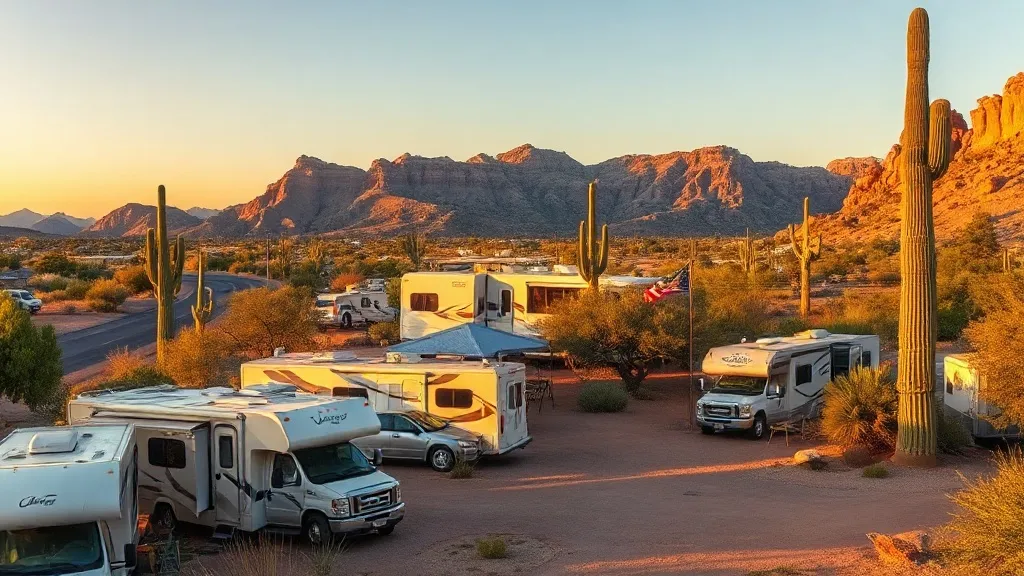
Gilbert Ray Campground is the public campground to choose for a saguaro-filled base west of Tucson—provided your complete rig is no longer than 40 feet. The current RV fee is $35 per night for an electric site. The campground has 138 total sites: 130 electric RV sites and eight tent-only sites, and every site is reservation-only.
Three facts eliminate most booking mistakes. RV pedestals provide 20-, 30- and 50-amp electricity, but no water or sewer connection at the pad. The campground is open September 1 through April 30 and closed May 1 through August 31. Loop H is no longer a first-come workaround; it follows the same reservation system as the other loops.
This review was checked against Pima County’s official campground, policy, reservation, direction and refund pages on August 5, 2026.
Gilbert Ray at a glance
| Detail | Current official information |
|---|---|
| RV fee | $35/night |
| Tent-only fee | $10/night |
| Total inventory | 138 sites |
| RV inventory | 130 electric sites |
| Tent inventory | 8 tent-only sites |
| Electric service | 20/30/50 amp at RV sites |
| Water / sewer at site | None |
| Dump station | One, for registered campers |
| Maximum rig | 40 feet total, including tow combination and extensions |
| Reservation rule | All sites reservation-only; up to one year ahead |
| Maximum stay | 7 days, then 7 days outside the park |
| Season | September 1–April 30; closed May 1–August 31 |
Campsite loops and inventory
Gilbert Ray is organized into four loops. Pima County’s loop counts add up as follows:
- Loop A: 75 sites, including one tent-only site
- Loop B: 5 tent-only sites
- Loop C: 30 sites, including one tent-only site
- Loop H: 28 sites, including one tent-only site
That yields 130 RV sites and eight tent-only sites. The old 135-site number undercounted the campground, and describing Loop B’s five sites as the entire tent inventory missed the tent sites embedded in A, C and H.
All RV sites have 20/30/50-amp electrical service. There is no water or sewer hookup at an individual pad. Fill the fresh tank before settling in and plan gray- and black-tank capacity around the shared dump station.
The pads sit in natural Sonoran Desert vegetation rather than a landscaped resort. That setting is the main amenity: saguaros, palo verde and Tucson Mountain views immediately around camp. It also means cactus, wildlife and uneven natural terrain deserve more attention than they would in a paved commercial park.
The 40-foot total-rig rule
Pima County defines the limit as 40 feet total, not “a 40-foot trailer plus tow vehicle.” The measurement includes the combined tow vehicle and trailer or towed setup, plus attached extensions such as racks or carriers. Towed vehicles must be disconnected in the main parking lot.
This is unusually restrictive for fifth wheels and travel trailers because the tow vehicle counts. Measure the traveling configuration from the foremost point to the rearmost attachment before booking. A directory saying a particular pad looks long does not override the policy.
If the complete combination exceeds 40 feet, use our Tucson RV parks guide to find private full-hookup options with equipment-specific sites.
Reservations: no first-come sites
Every Gilbert Ray campsite now requires a reservation, including Loop H. Reservations open up to one year in advance. There is no reliable same-day first-come loop to use when the calendar is full.
The maximum stay is seven days. After seven days, campers must remain outside the park for at least another seven days before returning. That makes Gilbert Ray a sightseeing base rather than a monthly snowbird park.
The published cancellation policy is strict: cancellations made at least 14 days before arrival receive a 50% refund; cancellations inside 14 days receive no refund. Check dates and rig length carefully before paying.
Seasonal closure
Gilbert Ray operates from September 1 through April 30 and closes from May 1 through August 31. It is not a year-round electric bargain, and there is no summer Loop H availability.
The operating season aligns with Tucson’s most comfortable camping weather. Winter demand can be high, while September and April can still be hot. Electricity supports air conditioning, but there is no shower or water connection listed at the campsite, so heat also increases fresh-water needs.
Hookups and facilities
Electricity
RV sites provide 20-, 30- and 50-amp outlets. Match the cord and surge protection to the pedestal and manage high-draw appliances normally. The former claim that the campground was 30-amp only is outdated.
Water and sewer
There are no individual water or sewer hookups. A shared dump station serves registered campers. Arrive with an appropriate fresh-water plan and avoid moving a 40-foot combination through camp merely because the gray tank filled sooner than expected.
Restrooms and showers
Pima County lists campground bathrooms and the dump station. A shower is not listed among the official campground facilities, so travelers should plan to use their RV shower rather than assuming a bathhouse shower is available.
Fires and cooking
Fires and propane fire pits are prohibited. Charcoal is not an allowed workaround. The current policy permits propane grills, camp stoves and cooking devices with an on/off switch. This is a material change from older descriptions that suggested charcoal grills were allowed.
Quiet hours run 10 p.m.–6 a.m. Check-in is noon and checkout is 11 a.m. A site allows up to six people and two vehicles under current policy.
RV-safe directions
The official address is 8451 W. McCain Loop, Tucson, AZ 85735. The 85743 ZIP code in the former version was incorrect.
Pima County says Gates Pass is not recommended for trailers or RVs longer than 24 feet. Its campground policy directs RVs over 25 feet to use Ajo Highway and Kinney Road. Those two thresholds are differently worded on the official pages, but their practical message is the same: do not route a large rig over Gates Pass.
Plan the approach before leaving the highway, and do not let general-purpose navigation send the RV onto the scenic passenger-car route. The longer Ajo Highway/Kinney Road approach is the prudent route for an RV that is still within Gilbert Ray’s 40-foot total limit.
Why stay here?
Gilbert Ray is in Tucson Mountain Park, near the Arizona-Sonora Desert Museum and the Tucson Mountain District of Saguaro National Park. It works as a low-service base for travelers whose priority is desert landscape and west-side attractions rather than a pool, laundry room or reliable campground Wi-Fi.
Saguaro National Park does not have a developed frontcountry campground. That makes Gilbert Ray especially useful: you can camp in county parkland close to the west district, return to electricity at night and avoid a longer daily commute from the east side of Tucson.
For a longer Arizona route, compare Rancho Sedona RV Park, Dead Horse Ranch State Park and our best RV parks in Arizona.
The honest review
What works
The setting is the attraction. Sites are embedded in the Sonoran Desert rather than separated from it by a decorative landscape strip. For photographers, birders and first-time Arizona visitors, that is a stronger reason to book than a generic amenity list.
The $35 fee includes useful electricity. Having 20/30/50-amp service at all 130 RV sites is meaningful in the desert and more flexible than the old 30-amp-only description suggested.
The rules are clear. A one-year reservation window, seven-day stay limit and 40-foot total-rig rule allow a traveler to decide quickly whether the campground fits.
West Tucson attractions are close. The location reduces backtracking to the Desert Museum and Saguaro’s west district.
What does not work for everyone
The rig limit excludes many tow combinations. A trailer can be well under 40 feet and still exceed the rule once the truck and carrier are counted.
There are no water or sewer hookups at the pad. The dump station helps, but a seven-day stay still requires deliberate tank management.
It is closed all summer. Travelers building a June–August itinerary must choose another campground rather than hoping for off-season availability.
Reservations are mandatory. Loop H is not a first-come backup, and the refund policy gives back only half even when a cancellation is made at least two weeks ahead.
This is not a resort. Do not expect a pool, on-site store, laundry or organized activities. A shower is not listed on the official facilities page.
Who should book Gilbert Ray?
Book it if your total traveling setup measures 40 feet or less, you are self-contained for water and wastewater, and you want a close base for the Tucson Mountains. It is especially strong for a short fall, winter or spring visit centered on the Desert Museum and Saguaro National Park.
Choose another park if the tow combination exceeds 40 feet, you need full hookups, you want a stay longer than seven days, or your dates fall between May 1 and August 31.
Full specs
- Address: 8451 W. McCain Loop, Tucson, AZ 85735
- Phone: 520-724-5159
- Sites: 138 total; 130 RV and 8 tent-only
- RV fee: $35/night
- Tent fee: $10/night
- Electric: 20/30/50 amp at RV sites
- Water/sewer at site: None
- Dump station: One for registered campers
- Maximum rig: 40 feet total combination including attachments
- Season: September 1–April 30
- Reservations: Required for every site, up to one year ahead
- Maximum stay: 7 days, followed by 7 days out
- Check-in / checkout: Noon / 11 a.m.
- Quiet hours: 10 p.m.–6 a.m.
- Fires: Prohibited; propane cooking devices with on/off switch allowed
- Official information: Pima County Gilbert Ray Campground
Frequently Asked Questions
How much is Gilbert Ray Campground?
The current official fee is $35 per night for an electric RV site and $10 per night for a tent-only site. RV sites have 20/30/50-amp electricity but no water or sewer connection at the pad.
Is Gilbert Ray Campground first come, first served?
No. Every site is reservation-only, including Loop H. Reservations open up to one year ahead through Pima County.
Is Gilbert Ray Campground open in summer?
No. It is open September 1 through April 30 and closed May 1 through August 31.
What is the RV length limit at Gilbert Ray?
The maximum is 40 feet for the complete traveling combination. That includes the tow vehicle and trailer or towed setup plus racks, carriers and other extensions.
Does Gilbert Ray have full hookups?
No. RV sites have electricity only. There is no water or sewer connection at the pad, and one shared dump station serves registered campers.
Can an RV use Gates Pass Road to reach Gilbert Ray?
Pima County says Gates Pass is not recommended for RVs or trailers over 24 feet and directs RVs over 25 feet to use Ajo Highway and Kinney Road. Plan the safer route before driving.
About the author
Marisol ReyesCamping & Outdoors Editor
Marisol spent six years as an interpretive ranger in the California and Colorado state park systems before turning to writing full-time. She knows public-land camping from the inside — how reservation windows really work, why some loops fill before others, and which 'first-come, first-served' sites are worth gambling on.
More from Marisol →Campgrounds in this guide
Facts pages for each park — hookups, rig limits, rates and booking, plus every guide that covers it.
Keep reading
Dead Horse Ranch State Park Camping: RV Sites & Fees (2026)
Verified Dead Horse Ranch State Park camping guide covering the $50 RV fee, 106 electric sites, loop sizes, 65-foot combination fit, reservations, showers, dump station, and Sedona trade-offs.
Flagstaff KOA Holiday Review: RV Sites & Big-Rig Fit (2026)
A verified 2026 Flagstaff KOA review covering full and partial hookups, the 75-foot campground maximum, live prices, patio sites, current fire alerts, and big-rig trade-offs.
Verde Ranch RV Resort Review: Sites, Rates & Rules (2026)
Verified Verde Ranch RV Resort review covering 389 full-hookup sites, 75-foot pull-throughs, live rates, monthly costs, Wi-Fi, pool, pet rules, and Sedona trade-offs.